I read through some of the comments on YouTube and a common perception amongst viewers is that we keep our goats in a little prison like cell, which makes me so sad. *sigh* I swear to you, our goats have a good life. Yes, sometimes they get cooped up in the pen for too long, but they get access to the rest of the yard and the neighbor's. I have seen pens in the country with just as small of a space as we use for our girls. Don't forget, aside from terrorizing the backyard weeds and rose bushes, they also go for strolls around the neighborhood and canters through beautiful McLaren park.
Showing posts with label urban chickens. Show all posts
Showing posts with label urban chickens. Show all posts
Monday, December 5, 2011
How Embarrassing!
Awhile back, I was interviewed by *fair companies, a website with a ton of awesome videos and resources on sustainable culture. To tell you the truth, I had forgotten all about it until I received an email from the videographer, Kirsten Dirkson. I think we spent less than an hour shooting, which amazes me that they could turn out such a lengthy video with so little footage. What I love most about it is that it has a much more natural feel to it, in contrast to our more highly produced video for the Whole Food's Grow program. But OMG, I am so embarrassed by the state of my disheveled backyard and messy, cluttered refrigerator. And check out those "There's Something about Mary" bangs! I thought I was being so clever with that kerchief, hiding away the bad hair day. Total fail.
I read through some of the comments on YouTube and a common perception amongst viewers is that we keep our goats in a little prison like cell, which makes me so sad. *sigh* I swear to you, our goats have a good life. Yes, sometimes they get cooped up in the pen for too long, but they get access to the rest of the yard and the neighbor's. I have seen pens in the country with just as small of a space as we use for our girls. Don't forget, aside from terrorizing the backyard weeds and rose bushes, they also go for strolls around the neighborhood and canters through beautiful McLaren park.
I read through some of the comments on YouTube and a common perception amongst viewers is that we keep our goats in a little prison like cell, which makes me so sad. *sigh* I swear to you, our goats have a good life. Yes, sometimes they get cooped up in the pen for too long, but they get access to the rest of the yard and the neighbor's. I have seen pens in the country with just as small of a space as we use for our girls. Don't forget, aside from terrorizing the backyard weeds and rose bushes, they also go for strolls around the neighborhood and canters through beautiful McLaren park.


Monday, September 19, 2011
An Open Letter to James McWilliams: On Hatching a Plan to Get the Real Inexpert Killers - Cats
Dear James,
Boy was I surprised to see that little ol' me made it into one of your articles in the Atlantic. I wouldn't have even known about it if it weren't for someone leaving a comment on my blog. She was nice enough to post a link so I clicked over to see your article on backyard animal slaughter and I thought "Hot diggity damn, we must have taken down the hideous beast that is the industrial meat processing complex!" I mean why else would we be talking about a handful of "inexpert" urban farming enthusiasts, like myself, killing a few chickens and rabbits when professional chicken slaughtering facilities botch well over 1 billion kills per year. During the process of shipping poultry in cramped cages there are around 54 million per year that either die from being heated or frozen to death during transportation; then the poor cluckers are hung by chains where 900 million have their wings broken; the final phase includes dunking them in an electrocution bath, sending them assembly line to a rotary blade that slices their necks, and dipping them into scalding water to ease feather plucking during which time 180 million birds are either improperly electrocuted and/or sliced and then are essentially scalded alive. I'm the kind of gal that keeps up with what's going on in our food system so news as big as overthrowing this horrendous operation surely couldn't have escaped my notice. And after a Google search, I see that it hasn't happened. Well that's disappointing, thought not exactly surprising given Big Ag's strangle hold on government policy.
So why were you writing about me? I mean I'm flattered and all, but I've got exactly 990 well appreciated fans. Not much of a pulpit, I'd say.
Well I read on, but I didn't see my name anywhere. Damn dude, if you're going to give a girl press, you could at least give me my props. I got to a passage where the words sounded familiar and suddenly I was jolted back to that horrific day when I had to kill sweet Pearl, my incurably sick laying hen. Yeah, that was a bad day. Having never killed an animal before, a beginner so to speak, or "inexpert" as you like to put it, which I might say is a synonym for beginner, but then I'm no linguist - I didn't do such a graceful job. Thanks for the memories, buddy.
And then I thought, what the hell does fucking up ending a life that was already enduring "immense suffering" have to do with backyard slaughtering for food? 'Cause like Pearl was diseased and shit and looked really fucked up. No one was going to eat her. She was never intended for the proverbial chopping block either. She was just supposed to lay real nice eggs and have feathers on her feet which I thought was a really neat thing - to have feathers on your feet, that is. I mean I'd want to have feathers on my feet if I could grow them. Wouldn't you? It's not like I'm proud of the fact that I suffocated a chicken. I really thought this was evident and that the brutally detailed writing of the incident was like a warning to others to not do what I had so ineptly done. But since she had been slowly suffocating for days and days, gasping for air at 3-5 second intervals, I'm not sure that hastening her demise in the same vein was anymore of a tragic end.
Anyways, I made my way through the entire article and still I couldn't figure out what Pearl had to do with your argument. Actually, if you don't mind me asking, what was your point exactly? From what I could make out, you're saying that beginning farmers shouldn't be allowed to kill their animals because as beginners we would make a "bloody mess" so we should just leave it to the Big Ag pros to do the deed, no matter how ugly since it would be done at a "graceful distance". For reals? That's your argument? Like, did you get that off a crackhead on the street? I say this only because I can't think of anyone else who could look at the industrial slaughterhouse numbers and rationalize this. Even if we had every single man, woman, and child in the U.S. bungle one slaughter each this year, we would still have more than three times as many inhumane poultry deaths leaving it up to the pros. But unlike machines, humans have the capacity to learn from their mistakes. So wouldn't it be better if people took killing their meat into their own hands since over time there would be a lot less suffering involved?
I was even more boggled about your purpose with the incomplete Emerson quote about "graceful distance", which in full says "You have just dined, and however scrupulously the slaughterhouse is concealed in the graceful distance of miles, there is complicity." At this point, I had no idea what the fuck you were talking about anymore. Should we remain complicit? Or did you purposely leave off the rest of that quote so that the logical conclusion would be drawn: all meat eating is culpable in the kill? How does that serve the overall point of leaving the slaughtering up to the pros? Or are we also not supposed to go with the big guy 'cause we'd still be guilty? Are we subtly being told not to eat meat lest we commit that mortal sin against your personal ethics, veganisim, a position that you are never forthright about in your writings, but seem to consistently hint at? God, I love Wikipedia.
Aside from the fact that your argument has more holes in it than a block of Emmentaler (how are you able to keep a job at a major university espousing crap like this?), I was still stuck on the incident with Pearl and why it made it into the article. And I also wanted to know why the Atlantic used that bizarre picture of a four legged, wet hen being held inappropriately by the wings to talk about backyard animal slaughter (shit, you guys should have asked me; I've got a bunch of pics you could have purchased for like a bazillion dollars or something). So I contacted the Atlantic's research department to see if, indeed, your piece had actually been checked for accuracy:
While we wait for the Atlantic to get back to me on that one, I think we, you and me James, should consider who the real menaces are when it comes to inhumane deaths: Cats. Those little bastards are some cold-hearted motherfuckers, willfully shredding birds without a care as to how they get the job done. And they are fucking wasteful. Look at what they did to my poor bird, Lilyana:

I know. Totally fucked up. There's still a lot of meat left on her. That slimy long thing below her body is actually her trachea. At first I thought the cat had decapitated her, but in fact, it had just mangled the head beyond recognition.
We could end this immeasurable cruelty, James. I'm telling you, these cats have to go. There are too many of them and they are killing hundreds of millions of songbirds and other avian species each year, according to our government. If we could round them all up, we could send them off to the industrial poultry slaughtering facilities. I know a few of those crazy cat ladies would be totally pissed off, and I'm sure my mom wouldn't take it all that well since she loves cats, but it wouldn't really be that big of a deal 'cause it would all be done at a "graceful distance". We could rename the slaughtering facilities "Causchwitz". Catchy, isn't it? Though I would like to change the method of killing for the kitties and go with something a little less bloody, like gas chambers. Once all these blasted cats are gone, then we won't have to worry about all the gruesome deaths of the poor, defenseless birds. Well, I guess there would still be raccoons and opossums... while we're at it, we could take out those guys too!
Holy shit, James! Did you see how easy that was? We went from taking an unpleasant incident to Here Kitty Kitty Goebbels in only a few sentences. You see, that's what happens when we extrapolate a Final Solution from a small number of anecdotes. One minute you're trying to end suffering and the next you're creating mini gas chambers for felines. Just goes to show you how quickly things can get out of hand.
So the next time you find yourself writing an article, think about the larger picture first. Am I trying to end cruel practices or am I promoting a Causchwitz? Our theories can have unintended consequences, results that could be more gruesome than what we had imagined.
And I promise you that I won't go ahead with my cat gas chamber idea, though I will probably threaten my own cat, Luna, with Causchwitz since she has a horrible propensity to shit in the bathtub when she gets pissed off and I think that is nothing but rude and deserving of terrorizing, idle threats.
But I AM going to go ahead and kill my rooster. He's been crowing at midnight and that's unacceptable behavior on this farm. Don't worry, his death will be swift. I've learned much since my first time. You are more than welcome to come and help out if you are at all concerned that I might fuck up again.
Warmest Regards,
Heidi Kooy
P.S. By the way, the next time you put me in one of your articles, I would really appreciate it if you actually used my name, because when people Google "sadistic chicken suffocater", you can bet your sweet ass that I want to come up top of the list on that one. There's a resume I can build with that title. I'm just sure of it.
Boy was I surprised to see that little ol' me made it into one of your articles in the Atlantic. I wouldn't have even known about it if it weren't for someone leaving a comment on my blog. She was nice enough to post a link so I clicked over to see your article on backyard animal slaughter and I thought "Hot diggity damn, we must have taken down the hideous beast that is the industrial meat processing complex!" I mean why else would we be talking about a handful of "inexpert" urban farming enthusiasts, like myself, killing a few chickens and rabbits when professional chicken slaughtering facilities botch well over 1 billion kills per year. During the process of shipping poultry in cramped cages there are around 54 million per year that either die from being heated or frozen to death during transportation; then the poor cluckers are hung by chains where 900 million have their wings broken; the final phase includes dunking them in an electrocution bath, sending them assembly line to a rotary blade that slices their necks, and dipping them into scalding water to ease feather plucking during which time 180 million birds are either improperly electrocuted and/or sliced and then are essentially scalded alive. I'm the kind of gal that keeps up with what's going on in our food system so news as big as overthrowing this horrendous operation surely couldn't have escaped my notice. And after a Google search, I see that it hasn't happened. Well that's disappointing, thought not exactly surprising given Big Ag's strangle hold on government policy.
So why were you writing about me? I mean I'm flattered and all, but I've got exactly 990 well appreciated fans. Not much of a pulpit, I'd say.
Well I read on, but I didn't see my name anywhere. Damn dude, if you're going to give a girl press, you could at least give me my props. I got to a passage where the words sounded familiar and suddenly I was jolted back to that horrific day when I had to kill sweet Pearl, my incurably sick laying hen. Yeah, that was a bad day. Having never killed an animal before, a beginner so to speak, or "inexpert" as you like to put it, which I might say is a synonym for beginner, but then I'm no linguist - I didn't do such a graceful job. Thanks for the memories, buddy.
And then I thought, what the hell does fucking up ending a life that was already enduring "immense suffering" have to do with backyard slaughtering for food? 'Cause like Pearl was diseased and shit and looked really fucked up. No one was going to eat her. She was never intended for the proverbial chopping block either. She was just supposed to lay real nice eggs and have feathers on her feet which I thought was a really neat thing - to have feathers on your feet, that is. I mean I'd want to have feathers on my feet if I could grow them. Wouldn't you? It's not like I'm proud of the fact that I suffocated a chicken. I really thought this was evident and that the brutally detailed writing of the incident was like a warning to others to not do what I had so ineptly done. But since she had been slowly suffocating for days and days, gasping for air at 3-5 second intervals, I'm not sure that hastening her demise in the same vein was anymore of a tragic end.
Anyways, I made my way through the entire article and still I couldn't figure out what Pearl had to do with your argument. Actually, if you don't mind me asking, what was your point exactly? From what I could make out, you're saying that beginning farmers shouldn't be allowed to kill their animals because as beginners we would make a "bloody mess" so we should just leave it to the Big Ag pros to do the deed, no matter how ugly since it would be done at a "graceful distance". For reals? That's your argument? Like, did you get that off a crackhead on the street? I say this only because I can't think of anyone else who could look at the industrial slaughterhouse numbers and rationalize this. Even if we had every single man, woman, and child in the U.S. bungle one slaughter each this year, we would still have more than three times as many inhumane poultry deaths leaving it up to the pros. But unlike machines, humans have the capacity to learn from their mistakes. So wouldn't it be better if people took killing their meat into their own hands since over time there would be a lot less suffering involved?
I was even more boggled about your purpose with the incomplete Emerson quote about "graceful distance", which in full says "You have just dined, and however scrupulously the slaughterhouse is concealed in the graceful distance of miles, there is complicity." At this point, I had no idea what the fuck you were talking about anymore. Should we remain complicit? Or did you purposely leave off the rest of that quote so that the logical conclusion would be drawn: all meat eating is culpable in the kill? How does that serve the overall point of leaving the slaughtering up to the pros? Or are we also not supposed to go with the big guy 'cause we'd still be guilty? Are we subtly being told not to eat meat lest we commit that mortal sin against your personal ethics, veganisim, a position that you are never forthright about in your writings, but seem to consistently hint at? God, I love Wikipedia.
Aside from the fact that your argument has more holes in it than a block of Emmentaler (how are you able to keep a job at a major university espousing crap like this?), I was still stuck on the incident with Pearl and why it made it into the article. And I also wanted to know why the Atlantic used that bizarre picture of a four legged, wet hen being held inappropriately by the wings to talk about backyard animal slaughter (shit, you guys should have asked me; I've got a bunch of pics you could have purchased for like a bazillion dollars or something). So I contacted the Atlantic's research department to see if, indeed, your piece had actually been checked for accuracy:
Attention Fact Check Department and Editors of the Atlantic:
In your recent article, "The Locavore's Mistake: Deregulating Animal Slaughter" by James McWilliams, I see there is a quote from my blog and I'm curious as to why a mercy killing made it into the piece as it has nothing to do with the author's overall argument about backyard farmers killing animals for food. This should have been more than evident to any staff member who bothered to read the entire blog post. I know it's a tedious chore, but I would assume that a longstanding, illustrious magazine such as yours would go that extra mile in an effort to preserve good journalism.
I am also confused by two other issues in the article. 1. Why is Emerson only quoted in part? The entirety reads, "You have just dined, and however scrupulously the slaughterhouse is concealed in the graceful distance of miles, there is complicity." As far as I can tell, this would make no logical sense given the author's overall intent of arguing FOR a graceful distance. And 2. Why was a picture of a mutant, four-legged chicken used in association with backyard slaughter? How does this even remotely have anything to do with topic at hand? I expect this kind of journalistic sensationalism from trashy rags such as the National Enquirer, not a well reputed media outlet.
Thank you for addressing my questions. I look forward to your response.
Heidi Kooy, a.k.a. The Sadistic Chicken Suffocater
While we wait for the Atlantic to get back to me on that one, I think we, you and me James, should consider who the real menaces are when it comes to inhumane deaths: Cats. Those little bastards are some cold-hearted motherfuckers, willfully shredding birds without a care as to how they get the job done. And they are fucking wasteful. Look at what they did to my poor bird, Lilyana:

I know. Totally fucked up. There's still a lot of meat left on her. That slimy long thing below her body is actually her trachea. At first I thought the cat had decapitated her, but in fact, it had just mangled the head beyond recognition.
We could end this immeasurable cruelty, James. I'm telling you, these cats have to go. There are too many of them and they are killing hundreds of millions of songbirds and other avian species each year, according to our government. If we could round them all up, we could send them off to the industrial poultry slaughtering facilities. I know a few of those crazy cat ladies would be totally pissed off, and I'm sure my mom wouldn't take it all that well since she loves cats, but it wouldn't really be that big of a deal 'cause it would all be done at a "graceful distance". We could rename the slaughtering facilities "Causchwitz". Catchy, isn't it? Though I would like to change the method of killing for the kitties and go with something a little less bloody, like gas chambers. Once all these blasted cats are gone, then we won't have to worry about all the gruesome deaths of the poor, defenseless birds. Well, I guess there would still be raccoons and opossums... while we're at it, we could take out those guys too!
Holy shit, James! Did you see how easy that was? We went from taking an unpleasant incident to Here Kitty Kitty Goebbels in only a few sentences. You see, that's what happens when we extrapolate a Final Solution from a small number of anecdotes. One minute you're trying to end suffering and the next you're creating mini gas chambers for felines. Just goes to show you how quickly things can get out of hand.
So the next time you find yourself writing an article, think about the larger picture first. Am I trying to end cruel practices or am I promoting a Causchwitz? Our theories can have unintended consequences, results that could be more gruesome than what we had imagined.
And I promise you that I won't go ahead with my cat gas chamber idea, though I will probably threaten my own cat, Luna, with Causchwitz since she has a horrible propensity to shit in the bathtub when she gets pissed off and I think that is nothing but rude and deserving of terrorizing, idle threats.
But I AM going to go ahead and kill my rooster. He's been crowing at midnight and that's unacceptable behavior on this farm. Don't worry, his death will be swift. I've learned much since my first time. You are more than welcome to come and help out if you are at all concerned that I might fuck up again.
Warmest Regards,
Heidi Kooy
P.S. By the way, the next time you put me in one of your articles, I would really appreciate it if you actually used my name, because when people Google "sadistic chicken suffocater", you can bet your sweet ass that I want to come up top of the list on that one. There's a resume I can build with that title. I'm just sure of it.
Monday, September 12, 2011
Not Your Typical American Neighborhood

That's Sir Crows A Lot in the foreground. I've been meaning to "do him" as I've been afraid of annoying the neighbors. But then a funny thing happened on the way to the chopping block. I asked my Guatemalan neighbor, Isela, if my rooster had been bothering her. Without a second of hesitation she replied, "Of course not!" When I told her not to worry - that I was planning on taking him out soon, she cried "Nooooooooooooooh! I loooohve it. The sound is so peaceful." I don't believe I've ever heard of a rooster crow being described as such, but then what a relief to know that one of my most uptight neighbors was actually enjoying his cock-a-doodle-doos.
My plans hadn't changed though. Sir Crows A Lot, a.k.a. Fried, still had a date with the reaper. That was until I bumped into another neighbor, Vak, from the Philippines. He asked me if I still had my rooster and I assured him that that wouldn't be the case for much longer. When he queried what I meant by that, I made a slicing motion across the throat, which evidently translates in all cultures. With a far away, misty look in his eyes he replied, "Oh no! I love that sound. It reminds me of home."
In any other big city neighborhood, a rooster would be an irritation at best, if not an outrage. But not in my barrio, mixed with a third Asians from China, the Philippines, and Vietnam; a third Latinos from Central and South America; and a final third from a potpourri of places, most likely foreign. Here my rooster stands for something that American urban areas lack: a pastoral, homey feeling that one usually only finds in more remote places. His croons soothe the frazzled nerves of congestion weary souls longing for a bit of the country in their fast-paced, traffic-jammed, mass transit cramped, hectic lives. He brings a bit of tranquility and beauty in his sharp cries. Ironic, for sure, but no less invaluable or charming.
As far as rooster machismo goes, he's a pretty good guy. He doesn't mount the ladies with extreme force and no hen is missing back feathers, a serious issue with a lot of cocks. However, he could stand to be more vigilant as far as predators are concerned (there was an incident with a stray cat last week, which I will relate in a future post) and he doesn't serve much purpose for us since we aren't trying to breed our ladies. Still, I'm thinking I might keep him around until someone complains.
- Posted using BlogPress from my iPhone
Monday, June 13, 2011
June Happenings
June has been a weird month as far as weather. We've had several days of rain and howling gales that are more common for early spring. The rain hasn't been too unwelcome as it has kept the greens producing without watering, but we are already seeing signs of powdery mildew on the peas and the apple trees have white fuzzy fungus growing on them. It's not a lot of damage. The wind, however, is driving me nuts. I've always had a strong aversion to wind. It makes me irritable. Highly irritable. And it's pulled my bean plants out by the roots, bent the chard plants that I am trying to save seed from, and nearly ripped off the corrugated roofing on the animal pen that had been glued on with Sikaflex. Damn, that's an angry wind. No wonder I feel like I'm being rubbed the wrong way.
Aside from annoying weather, the apple tree is bursting with fruit. The bees have certainly done their work and it looks as though we will be heavily laden with apple pies, applesauce, apple whatever, and hopefully cider and cider vinegar. The husband is planning to make an apple press, but I'm not sure if he will be able to get to it in time. We should be wading through barrels upon barrels in less than two weeks.

Ethel says I need to repair this fence as the chicks keep escaping through this hole.

Speaking of the chicks, they have graduated to the big girl coop though are not so happy to spend their days with the full grown ladies. Sweet Pea is showing her not-so-sweet side by giving each chick a bit of what for. So they have taken to wandering under the apple tree for some daytime peace and weed munching. Today five of the six made it back to the pen while one of the Dark Cornishes cowered behind a piece of plywood. I think her legs are too big for her to get airborne. Two of the chicks even made it into the coop. That's a first and a good sign that I will spend less time in the evenings chasing recalcitrant chooks around the yard trying to get them to bed.

I'm really proud of the hoop house I set up in my neighbor's yard. Using only rebar, 1/2 inch PVC pipe, 6 mil plastic sheeting, and rubber-tipped clamps, I built the thing for less than $100. The neighbors only use the space to dump trash so I struck a deal with them that if I could use it to grow vegetables, I would keep the area neat and tidy. Thus far it's been an ideal arrangement and I plan to give them a good portion of the harvest.

The plants are absolutely ecstatic to be out of the wind and in some heat. The temperature is usually at least 10 to 15 degrees warmer than anywhere else on our lots. I've even rigged up the drip irrigation in there.

Look at these tomatoes! I was concerned that I might have to buy transplants again this year as I had left the seedlings out in the wind a few too many times. But once I popped them in the poly tunnel, all changed their tune.

I'll keep you updated as to how it works out. I've got more than a dozen varieties of tomatoes, several types of squash, a few cucumbers, beans, and melons growing in there. To think, I might produce a melon in San Francisco! If I'm successful, I will have defied the bounds of growing in a cold, foggy summer micro-climate. Good luck to me, eh?
Baby Bird Update - I'm pretty sure he found his mother. He flew out the window and has not been heard from since. I wish him the best.
- Posted using BlogPress from my iPhone
Aside from annoying weather, the apple tree is bursting with fruit. The bees have certainly done their work and it looks as though we will be heavily laden with apple pies, applesauce, apple whatever, and hopefully cider and cider vinegar. The husband is planning to make an apple press, but I'm not sure if he will be able to get to it in time. We should be wading through barrels upon barrels in less than two weeks.

Ethel says I need to repair this fence as the chicks keep escaping through this hole.

Speaking of the chicks, they have graduated to the big girl coop though are not so happy to spend their days with the full grown ladies. Sweet Pea is showing her not-so-sweet side by giving each chick a bit of what for. So they have taken to wandering under the apple tree for some daytime peace and weed munching. Today five of the six made it back to the pen while one of the Dark Cornishes cowered behind a piece of plywood. I think her legs are too big for her to get airborne. Two of the chicks even made it into the coop. That's a first and a good sign that I will spend less time in the evenings chasing recalcitrant chooks around the yard trying to get them to bed.

I'm really proud of the hoop house I set up in my neighbor's yard. Using only rebar, 1/2 inch PVC pipe, 6 mil plastic sheeting, and rubber-tipped clamps, I built the thing for less than $100. The neighbors only use the space to dump trash so I struck a deal with them that if I could use it to grow vegetables, I would keep the area neat and tidy. Thus far it's been an ideal arrangement and I plan to give them a good portion of the harvest.

The plants are absolutely ecstatic to be out of the wind and in some heat. The temperature is usually at least 10 to 15 degrees warmer than anywhere else on our lots. I've even rigged up the drip irrigation in there.

Look at these tomatoes! I was concerned that I might have to buy transplants again this year as I had left the seedlings out in the wind a few too many times. But once I popped them in the poly tunnel, all changed their tune.

I'll keep you updated as to how it works out. I've got more than a dozen varieties of tomatoes, several types of squash, a few cucumbers, beans, and melons growing in there. To think, I might produce a melon in San Francisco! If I'm successful, I will have defied the bounds of growing in a cold, foggy summer micro-climate. Good luck to me, eh?
Baby Bird Update - I'm pretty sure he found his mother. He flew out the window and has not been heard from since. I wish him the best.
- Posted using BlogPress from my iPhone
Monday, June 6, 2011
Chickens at Sunset
Holy cluckin' crap am I exhausted. This weekend kick ass urban farmer Esperanza Pallana of Pluck and Feather and I gave a presentation and fielded hundreds of questions on raising backyard chickens.

We asked for it and boy did those questions come. We were a very popular booth,

which may have had to do with the fact that I brought all of my chicks and hens for show and tell. The kids loved it.

And so did the adults. Most were smitten with the vintage camper inspired demonstration coop in our booth designed by John Wright. There were a lot of folks interested in the idea of chickens, but I was thoroughly shocked to meet so many Sunset readers who currently raise their own hens, some of whom have been doing it for years and years.My favorites may have been the friends of Dorothy trio living in Sacramento where one had been raising chickens on the sly for nearly 20 years. Apparently, it has been illegal in Sacramento since the 70s, but they are hoping to change the laws this upcoming month. I wish them the best of luck.
Another highlight from the event was this totally rad chicken coop called the Kippen House (Kippen means "chicken" in Dutch) that had a garden bed for a roof. It was absolutely gorgeous!

I didn't have much time to explore the rest of the festival with all the people wanting to chat chickens. I am so grateful that our friends over at FARMcurious and Dog Island happened to be there too, as they were indispensable in helping out with all the cluckin' questions. By the end of it all we were completely chickened out. I think Esperanza's face says it all.

- Posted using BlogPress from my iPhone

We asked for it and boy did those questions come. We were a very popular booth,

which may have had to do with the fact that I brought all of my chicks and hens for show and tell. The kids loved it.

And so did the adults. Most were smitten with the vintage camper inspired demonstration coop in our booth designed by John Wright. There were a lot of folks interested in the idea of chickens, but I was thoroughly shocked to meet so many Sunset readers who currently raise their own hens, some of whom have been doing it for years and years.My favorites may have been the friends of Dorothy trio living in Sacramento where one had been raising chickens on the sly for nearly 20 years. Apparently, it has been illegal in Sacramento since the 70s, but they are hoping to change the laws this upcoming month. I wish them the best of luck.
Another highlight from the event was this totally rad chicken coop called the Kippen House (Kippen means "chicken" in Dutch) that had a garden bed for a roof. It was absolutely gorgeous!

I didn't have much time to explore the rest of the festival with all the people wanting to chat chickens. I am so grateful that our friends over at FARMcurious and Dog Island happened to be there too, as they were indispensable in helping out with all the cluckin' questions. By the end of it all we were completely chickened out. I think Esperanza's face says it all.

- Posted using BlogPress from my iPhone
Sunday, June 5, 2011
Are You My Mother?
This evening I found this little guy peeping frantically outside the chicks' run.

Poor bugger was beating himself against the chicken wire mesh until he finally broke through to get at the chicks. I couldn't quite figure out his intents until I saw him squat underneath the girls with his beak gaping up wide open. This fledgling apparently lost his mama and figured the chicks would due as surrogates. Yeah, not really. The girls stared into the baby's mouth and did what any chicken would do. Went for the tongue like it was a tasty worm. I tried to get him inside and give him a little food, but he flew off into the basement rafters. After an hour's chase, climbing on furniture to try and capture the flighty devil, I gave up as I had had a long day at the Sunset Magazine Celebration. Let's hope this little tale has a Dr. Suess ending. If only I were a Snort. Then maybe I could find his mother.

Posted using BlogPress from my iPhone

Poor bugger was beating himself against the chicken wire mesh until he finally broke through to get at the chicks. I couldn't quite figure out his intents until I saw him squat underneath the girls with his beak gaping up wide open. This fledgling apparently lost his mama and figured the chicks would due as surrogates. Yeah, not really. The girls stared into the baby's mouth and did what any chicken would do. Went for the tongue like it was a tasty worm. I tried to get him inside and give him a little food, but he flew off into the basement rafters. After an hour's chase, climbing on furniture to try and capture the flighty devil, I gave up as I had had a long day at the Sunset Magazine Celebration. Let's hope this little tale has a Dr. Suess ending. If only I were a Snort. Then maybe I could find his mother.

Posted using BlogPress from my iPhone
Tuesday, May 31, 2011
An Open Letter to Mark Zuckerberg: On Your Decision to Kill What You Eat
Dear Mark,
Kudos to you for attempting to take responsibility for your meat consumption, to face the face behind the body on your plate. I mean this with all sincerity. For reals. Killing your dinner is not easy in this age of neatly cling wrapped, sterilized-looking pieces of flesh lying in styrofoam cartons. In our modern day food system, we've lost all connection between the ingredient and end product. I hope that your decision, being that you are an ultra famous twenty-something billionaire, will have an impact on our culture and encourage more folks to explore the acts that bring a meal to plate.
But I'm really curious as to why you have decided to focus solely on being the henchman in that final moment of the animal's life, the proverbial "money-shot" of meat production. I'm sure you realize that there is so much more in getting that birria to the stew pot. There is, of course, the daily shoveling of shit, feeding, watering, and making sure the animals stay healthy. And what about a farmer's concerns of being profitable in an industry that one can barely make a living at, even if using subsidized GMO grains for feed? Or that the farmer or slaughterhouse has to rely on cheap, usually illegal, immigrant labor in order to survive in those businesses? Are those things that you will be educating yourself on in your endeavor to learn more about where your food comes from?
I don't mean to be overly critical because I do truly admire your resolve. You remind me of my twenty-year-old vegetarian self who had determined that one should only eat meat if they could kill it themselves. At the time, I knew I wasn't capable of the killing so I chose not to eat animals. But now that I am a middle-aged, carnivorous, not-even-close-to-being-a-billionaire-in-my-wildest-dreams urban farmer, I have killed and I have discovered exactly what it takes to produce the food we eat. It's a lot of work, Mark. A lot of rote, dirty, smelly, unglamorous, low-valued work. In essence, much more than just the killing.
Maybe you already know all this. Maybe these are things that you think about. But let's face it, you're a billionaire who rubs elbows with presidents, king and queens, and the richest of the rich. You can essentially do anything you want. Is your foray into grim reaper any different from the wealthy dude who hangs off the back of his Hummer on his Texas estate safari shooting at tigers for a prized trophy head to hang over the mantle? OK, OK, maybe that's a bad analogy. You're not shooting endangered, exotic animals from the back of a gas guzzling SUV for the sake of putting another notch on your belt. Make no mistake though, killing for your own meat is a trophy of sorts, just like learning Chinese or wearing a tie every day for a year.
This may be hyperbole on my part, but can't you see how this smacks of Hameau de la Reine, Marie Antoinette's play farm where she pranced around pretending to be a dairymaid? Isn't this a bit of masquerading on your part? I mean, come on, you're a billionaire! You don't have to process one morsel of your own food if you choose not to. With your kind of money, you don't even have to lift your fork to your mouth. You really could pay someone to do that. It would be weird, but you could do it. People with your kind of wealth have an all access pass to do anything they want to do, including sauntering on to someone's farm and slaughtering animals. Any farmer would be more than happy to show you the ropes, probably for free, because you are Mark Zuckerberg, the Facebook guy and the youngest self-made billionaire EVER. You must know that you walk this earth in possession of more privilege than the other 95% of us combined. Can you see how this could look a little like "Oh, now he wants to amuse himself as farmer!" to the masses?
Maybe you're wondering why I'm being so hard on you. It could even look like jealousy since I'm more than a decade older than you without anything even remotely like your achievements under my belt and I am clearly not a billionaire and I'm possibly a little jealous that you are because I keep mentioning your wealth in, like, every other sentence. I promise I'm not pressing you on this issue, Mark, due to envy (though the billionaire thing does give me a twinge when my mortgage comes due). I just think that you could push yourself further on the "understanding where your food comes from" thing. If you are reading this, I'm sure you just muttered something like, "Hey crazy lady, I'm killing animals over here. What else do you think I should do?" Well I'll tell you: participate in how food is produced not just in how it meets its maker.
Mark, I've got a great challenge for you. Instead of just executing your meals, why don't you raise a small flock of meat birds and laying hens? This way you can really get to know your animal before it makes it to the chopping block. Why poultry? Well they are pretty low maintenance where livestock is concerned and you can get meat as well as eggs. If you could spend an hour a day learning Mandarin, you could certainly spend 30 minutes a day feeding and mucking the coop of your little clutch of ladies.
Each year you engage in the classic conflict of man versus himself, but with the challenge you have set forth for yourself this time around, you have a golden opportunity to experience the entire process, to see how the rest of the world has to work in order to survive. On a micro scale, of course. If you keep track of your input versus output, you will quickly realize that it is almost impossible to be a profitable farm, even with economies of scale. Meat is not only a question of the ethics of "passing the buck" in the brutality of it all, but an issue of social justice. How many billionaires take the time to explore that?
I took the liberty of looking up your city's codes and all you need is a permit. I know your neighbors might get their feathers a bit ruffled, but I'm sure you've got enough space on your $7 million property to be relatively discreet. You could also use it as an educational opportunity to inform your neighbors on the benefits of raising their own food. Even famous folks like Martha Stewart and Olympic swimmer Natalie Coughlin are doing it. You wouldn't be alone. I'll even help you get started. For free! This weekend I'll be at the Sunset Magazine Celebration Weekend in Menlo Park, next to your home town as you know, with my friend Esperanza giving out free info on raising backyard poultry. There will be a booth near ours where you can purchase an attractive coop for your chooks and you can pick up some nice birds right in Menlo Park from Little Cluckers.
I tell you, Mark, this is going to be a great project for you and really only a slight expansion of your original endeavor. I assure you it will be more than rewarding growing and harvesting food that you have raised with your own two hands. And think of the street cred you'll gain with fellow farmers going through the entire process from start to finish.
With much sincerity, admiration for your responsible meat eating (you've certainly gone further than I have), and gratitude for connecting me with friends whom I never would have gotten in touch with if not for Facebook (I'm going to look past that privacy issue for now since this is meant to be a letter of encouragement and not a "bag on Mark" note),
Heidi Kooy
P.S. I think you should throw in a mini-garden too. Growing vegetables is often harder than it looks and involves way more killing than most vegans would like to acknowledge. I know this from experience.
Kudos to you for attempting to take responsibility for your meat consumption, to face the face behind the body on your plate. I mean this with all sincerity. For reals. Killing your dinner is not easy in this age of neatly cling wrapped, sterilized-looking pieces of flesh lying in styrofoam cartons. In our modern day food system, we've lost all connection between the ingredient and end product. I hope that your decision, being that you are an ultra famous twenty-something billionaire, will have an impact on our culture and encourage more folks to explore the acts that bring a meal to plate.
But I'm really curious as to why you have decided to focus solely on being the henchman in that final moment of the animal's life, the proverbial "money-shot" of meat production. I'm sure you realize that there is so much more in getting that birria to the stew pot. There is, of course, the daily shoveling of shit, feeding, watering, and making sure the animals stay healthy. And what about a farmer's concerns of being profitable in an industry that one can barely make a living at, even if using subsidized GMO grains for feed? Or that the farmer or slaughterhouse has to rely on cheap, usually illegal, immigrant labor in order to survive in those businesses? Are those things that you will be educating yourself on in your endeavor to learn more about where your food comes from?
I don't mean to be overly critical because I do truly admire your resolve. You remind me of my twenty-year-old vegetarian self who had determined that one should only eat meat if they could kill it themselves. At the time, I knew I wasn't capable of the killing so I chose not to eat animals. But now that I am a middle-aged, carnivorous, not-even-close-to-being-a-billionaire-in-my-wildest-dreams urban farmer, I have killed and I have discovered exactly what it takes to produce the food we eat. It's a lot of work, Mark. A lot of rote, dirty, smelly, unglamorous, low-valued work. In essence, much more than just the killing.
Maybe you already know all this. Maybe these are things that you think about. But let's face it, you're a billionaire who rubs elbows with presidents, king and queens, and the richest of the rich. You can essentially do anything you want. Is your foray into grim reaper any different from the wealthy dude who hangs off the back of his Hummer on his Texas estate safari shooting at tigers for a prized trophy head to hang over the mantle? OK, OK, maybe that's a bad analogy. You're not shooting endangered, exotic animals from the back of a gas guzzling SUV for the sake of putting another notch on your belt. Make no mistake though, killing for your own meat is a trophy of sorts, just like learning Chinese or wearing a tie every day for a year.
This may be hyperbole on my part, but can't you see how this smacks of Hameau de la Reine, Marie Antoinette's play farm where she pranced around pretending to be a dairymaid? Isn't this a bit of masquerading on your part? I mean, come on, you're a billionaire! You don't have to process one morsel of your own food if you choose not to. With your kind of money, you don't even have to lift your fork to your mouth. You really could pay someone to do that. It would be weird, but you could do it. People with your kind of wealth have an all access pass to do anything they want to do, including sauntering on to someone's farm and slaughtering animals. Any farmer would be more than happy to show you the ropes, probably for free, because you are Mark Zuckerberg, the Facebook guy and the youngest self-made billionaire EVER. You must know that you walk this earth in possession of more privilege than the other 95% of us combined. Can you see how this could look a little like "Oh, now he wants to amuse himself as farmer!" to the masses?
Maybe you're wondering why I'm being so hard on you. It could even look like jealousy since I'm more than a decade older than you without anything even remotely like your achievements under my belt and I am clearly not a billionaire and I'm possibly a little jealous that you are because I keep mentioning your wealth in, like, every other sentence. I promise I'm not pressing you on this issue, Mark, due to envy (though the billionaire thing does give me a twinge when my mortgage comes due). I just think that you could push yourself further on the "understanding where your food comes from" thing. If you are reading this, I'm sure you just muttered something like, "Hey crazy lady, I'm killing animals over here. What else do you think I should do?" Well I'll tell you: participate in how food is produced not just in how it meets its maker.
Mark, I've got a great challenge for you. Instead of just executing your meals, why don't you raise a small flock of meat birds and laying hens? This way you can really get to know your animal before it makes it to the chopping block. Why poultry? Well they are pretty low maintenance where livestock is concerned and you can get meat as well as eggs. If you could spend an hour a day learning Mandarin, you could certainly spend 30 minutes a day feeding and mucking the coop of your little clutch of ladies.
Each year you engage in the classic conflict of man versus himself, but with the challenge you have set forth for yourself this time around, you have a golden opportunity to experience the entire process, to see how the rest of the world has to work in order to survive. On a micro scale, of course. If you keep track of your input versus output, you will quickly realize that it is almost impossible to be a profitable farm, even with economies of scale. Meat is not only a question of the ethics of "passing the buck" in the brutality of it all, but an issue of social justice. How many billionaires take the time to explore that?
I took the liberty of looking up your city's codes and all you need is a permit. I know your neighbors might get their feathers a bit ruffled, but I'm sure you've got enough space on your $7 million property to be relatively discreet. You could also use it as an educational opportunity to inform your neighbors on the benefits of raising their own food. Even famous folks like Martha Stewart and Olympic swimmer Natalie Coughlin are doing it. You wouldn't be alone. I'll even help you get started. For free! This weekend I'll be at the Sunset Magazine Celebration Weekend in Menlo Park, next to your home town as you know, with my friend Esperanza giving out free info on raising backyard poultry. There will be a booth near ours where you can purchase an attractive coop for your chooks and you can pick up some nice birds right in Menlo Park from Little Cluckers.
I tell you, Mark, this is going to be a great project for you and really only a slight expansion of your original endeavor. I assure you it will be more than rewarding growing and harvesting food that you have raised with your own two hands. And think of the street cred you'll gain with fellow farmers going through the entire process from start to finish.
With much sincerity, admiration for your responsible meat eating (you've certainly gone further than I have), and gratitude for connecting me with friends whom I never would have gotten in touch with if not for Facebook (I'm going to look past that privacy issue for now since this is meant to be a letter of encouragement and not a "bag on Mark" note),
Heidi Kooy
P.S. I think you should throw in a mini-garden too. Growing vegetables is often harder than it looks and involves way more killing than most vegans would like to acknowledge. I know this from experience.
Thursday, May 26, 2011
Pop Tart (Coq) au Vin
The time had come to honor the circle of life here at Itty Bitty. Pop Tart had been marinating in the freezer for six months and Monica, the Irish lass who found the poor divil lying dead at the foot of the coop, is off to her motherland for the summer. Clearly, a bon voyage party, with Pop Tart at the helm, was called for. But what to do with a stewing hen?
Ask around and you'll get a lot of naysayers to the eating of an aged egg layer. They'll tell you that the meat isn't fit for consumption; that it will be tough and stringy and disgusting. Well I'm here to tell you that they are wrong, wrong, wrongity wrong.
The folks that think a stewing hen is inedible are the ones who are attempting to prepare it like a broiler. That doesn't work. Broiler chickens, the kind that you buy at the store tidily wrapped in clinging plastic and styrofoam, are harvested at around eight weeks. Eight weeks, people! The incredible rate of growth is mind-boggling, unless you see it firsthand. Think about it. That creature hatches at only a few ounces and then puts on nearly a pound of weight a week. Those muscles that end up on your dinner plate probably haven't even been properly stretched. Talk about fresh, young meat. But of course a hen or rooster that has been running around the yard for a couple years will be a tad more rough and tumble in taste and texture, the tenderness and succulence of adolescence long gone. The secret to preparing one of these old cluckers is the same as with any tough cut of meat: cook the shit out of it for a really really long time under low heat.
I knew that I would have to find a tried and true recipe to prepare Pop Tart's thin frame so I turned to Hugh Fearnley-Whittingstall, British author of the award winning The River Cottage Meat Book, my crockpot, and the French. Coq au vin, as the name suggests, obviously descends from the French. Long considered a peasant dish, an old rooster who was losing his abilities between the legs would be cast into the stewing pot along with some wine, onions, mushrooms, salt pork and a bouquet garni. The lengthy cooking period broke down the tough connective tissues that tend to build up in older, active birds, creating a tasty and inexpensive meal. My modern version utilizes my crockpot for the slow, low temp cooking. Today, coq au vin is most often prepared with broilers and cooked for shorter periods of time. What a waste, I say. Let's create a stewing hen revival. I know Hugh is on board. He has several videos (look for more info in my next post) on his experience as a small holder, of which the American translation would probably be "hobby farmer", where he advocates for using all of one's resources in a sensible, holistic manner. He would never let an old rooster or hen go to naught.
Hugh's recipes have never steered me wrong so I went with a variation on his coq au vin.
Ingredients:
Little Pop Tart strutted across the stage of existence one last time in a serving vessel fit for a queen (one of my finest thrift store finds).

We served her with a lovely spread of homegrown artichoke hearts, homegrown pickled carrots, pickled beets, and grilled asparagus. Her flesh, atop heaps and heaps of mash, transformed into a toothsome meal good enough for any king.

And we, the court, made merry one last time before our summer apart.

What will I do without my farm sitter?
Ask around and you'll get a lot of naysayers to the eating of an aged egg layer. They'll tell you that the meat isn't fit for consumption; that it will be tough and stringy and disgusting. Well I'm here to tell you that they are wrong, wrong, wrongity wrong.
The folks that think a stewing hen is inedible are the ones who are attempting to prepare it like a broiler. That doesn't work. Broiler chickens, the kind that you buy at the store tidily wrapped in clinging plastic and styrofoam, are harvested at around eight weeks. Eight weeks, people! The incredible rate of growth is mind-boggling, unless you see it firsthand. Think about it. That creature hatches at only a few ounces and then puts on nearly a pound of weight a week. Those muscles that end up on your dinner plate probably haven't even been properly stretched. Talk about fresh, young meat. But of course a hen or rooster that has been running around the yard for a couple years will be a tad more rough and tumble in taste and texture, the tenderness and succulence of adolescence long gone. The secret to preparing one of these old cluckers is the same as with any tough cut of meat: cook the shit out of it for a really really long time under low heat.
I knew that I would have to find a tried and true recipe to prepare Pop Tart's thin frame so I turned to Hugh Fearnley-Whittingstall, British author of the award winning The River Cottage Meat Book, my crockpot, and the French. Coq au vin, as the name suggests, obviously descends from the French. Long considered a peasant dish, an old rooster who was losing his abilities between the legs would be cast into the stewing pot along with some wine, onions, mushrooms, salt pork and a bouquet garni. The lengthy cooking period broke down the tough connective tissues that tend to build up in older, active birds, creating a tasty and inexpensive meal. My modern version utilizes my crockpot for the slow, low temp cooking. Today, coq au vin is most often prepared with broilers and cooked for shorter periods of time. What a waste, I say. Let's create a stewing hen revival. I know Hugh is on board. He has several videos (look for more info in my next post) on his experience as a small holder, of which the American translation would probably be "hobby farmer", where he advocates for using all of one's resources in a sensible, holistic manner. He would never let an old rooster or hen go to naught.
Hugh's recipes have never steered me wrong so I went with a variation on his coq au vin.
Ingredients:
- old laying hen
- onions
- a couple bulbs of green garlic
- 1/2 pound button mushrooms
- 1/2 pound bacon
- half a glass of brandy
- 2 cups red wine (I used Bogle's Merlot)
- 2 cups water
- a bouquet garni of celery, parsley, thyme, and bay leaf
- pepper to taste
Little Pop Tart strutted across the stage of existence one last time in a serving vessel fit for a queen (one of my finest thrift store finds).

We served her with a lovely spread of homegrown artichoke hearts, homegrown pickled carrots, pickled beets, and grilled asparagus. Her flesh, atop heaps and heaps of mash, transformed into a toothsome meal good enough for any king.

And we, the court, made merry one last time before our summer apart.

What will I do without my farm sitter?
Wednesday, July 21, 2010

Friday, April 23, 2010
Catching Up with the Farm
My dearest, loyal IBFITC readers (I guess I'm talking to you mom and dad), I profusely apologize for the posting desertification. All I can say is that it was tax time, my busiest time of the year. I believe I've mentioned here before that I am a die-hard procrastinator. I don't just wait until the last minute to do the taxes, I wait until three weeks before taxes are due to start entering last year's books for our businesses. What can I say, I'm highly motivated by deadlines. So I guess I'll just give you all a run down on what's been happening around here over the last three weeks.
Here Comes the Sun
We've been approved! For our solar project that is. I know I never even mentioned it before, but it was one of those things I was meaning to get around to. The gray water system was supposed to come first, but then I found out about this great deal.
I've dreamed of living in a solar powered home since my college days, which was *cough cough* 20 years ago or there abouts (Yeah, I may be middle-aged, but I still have the butt of a 20 year old, so there!). With the $17 grand price tag being the cheapest deal I could find, I figured I'd be waiting another 20 years to realize my dream. But then I ran into this guy at a local Meetup for chicken owners in the Bay Area who works for 1 Block Off the Grid and he told me that I could get the whole thing financed through this company called SunRun, all for the low low start up cost of $3 grand. In a nut shell, the dealio is that you pay this up front cost for installation, SunRun purchases and owns the panels, and then you buy back the power your panels produce from SunRun for a monthly flat fee, which is pretty much the same as your current electric bill. The super awesome perks are that it's an 18 year contract where SunRun is 100% liable for the maintenance and upkeep of your system, including any damage that might incur to other people's property (you know, just in case those gargantuan panels blew off your roof and landed on your neighbor's). And your bill will not go up unless you are using more energy than you are producing with your panels so you avoid the yearly rate increases saving a ton of money in the end. Not to mention that all that guilty pleasure Facebook time won't be powered by dirty coal. Although it will cost more than buying the panels outright, we love the flexibility of not being responsible for them and that we can choose to buy the panels at the end of our contract or just let SunRun take them back. Who knew chickens could lead us directly to solar power?
Chickens
I would like to report that the chickens are grieving the absence of the goats, but alas, I think they're a touch relieved that they don't have to worry about being stepped on when the nutty goat antics start in. Every morning Pop Tart greets me with the "mount me" pose so I give her a back scratch and a little rub on the sides of her tail, a daily ritual as regular and scheduled as teeth brushing around here. But that's the best I'm going to do for her when it comes to beckoning to be bred. However, I did have to cross that line with Sweet Pea this week.
I found my darling bird straining one morning and was wondering if she had an egg stuck or something. I fear egg binding like a rooster fears the presence of a fox in the hen house. The removal procedure is beyond unappealing (***WARNING*** graphic discussion to follow.), as it entails sticking one's fingers as far up the chicken's backside as it will go, feeling for the egg, and trying to carefully guide the egg out without breaking it since that could cut up the intestines and cause death. You all know how I feel about more death. So I picked up Sweet Pea to get a gander at what was going on.
Well I found half a poo hanging out of her vent along with a bunch of her insides. "Damn it," I thought, "Another freakin' prolapse!" Yes, this was not my first experience with cloaca prolapse. When Eggo laid her first egg, the shell was soft and rubbery so the poor little babe strained so hard that her insides came out. Think of it as a really bad chicken hemorrhoid, like the kind ladies get when they give birth (consider yourself beyond fortunate if you have no idea what I am talking about). Most of the advice on the intraweb recommended culling, mainly because chickens get all riled up about blood and will peck an injured bird to death. I thought culling sounded a bit harsh and was glad that wasn't the prognosis for me after I gave birth to my daughter. Damn, that was ugly. Then I found some other handy advice that suggested sugar, witch hazel / Preparation H, triple antibiotic ointment, or honey to reduce swelling by slathering some on the vent and popping the innards back in. I like to cover all bases and thus made a concoction including all the above indications, washed down Eggo's back end, put the mixture on the bird's butt, and removed her from the others for a few days. She hasn't had a problem since.
In Sweet Pea's case, I didn't bother with the bath or the cover-all-bases remedy. I just stuck my finger inside to see, or I guess feel (strange how the inside of a chicken feels just like a vagina) would be the appropriate verb, what was going on and it seemed like she had a big crap that was distending her intestines (at least I think chickens have intestines) at a weird angle, kind of like diverticulitis, making it hard for her to get the doodie out. So I did what any caretaker would do and removed it for her. The DF feigned tossing his cookies as I scooped out a finger full of crap and flicked it on the ground. He swore he would never eat my cooking again. After all poop was removed, I pushed the bulge back in, which was a bit bloody from all the man-handling, and prayed that she would be fine. I couldn't properly tend to her that day as I had a shitload of errands to run. I'm happy to announce that her butt is fine and that she started laying eggs again the day after her injury.
OROAR Update
That electric fencing is really doing its job keeping out all the undesirables. In fact, most of the garden is recovering nicely with some peas and favas returning from the dead. The Zimbabwe bucket method was not as promising as I had hoped. Maybe it had to do with the fact that I used a toilet paper roll core smothered in peanut butter instead of a corncob (where the hell would I find a dried corncob at this time of the year I'd like to know) and placed it on a wooden skewer instead of a metal one, which enabled the critters to knock the stick into the bucket, thus ruining the trap. Well the electric fence is working. It's actually working so well that when I tried to put in some transplants, I kept getting a jolt every time I touched the wires. It's only on at night, but I guess the system will continue to discharge during the day. I'll post some garden pics once things get a bit taller.
Goats
According to the breeder, Lucy has been successfully bred! And as I suspected, she got her love on the day after we dropped her off. I admire her efficiency with the whole endeavor. Since she hasn't shown any signs of estrus in the past four weeks, it's probably safe to pick her up. We plan to head up there the weekend of May 1st, which is of great relief to the CW as her teacher has informed me that she has been crying at school because she misses her goats so much. We all miss them. Even the DF has remarked that things just aren't the same without all the "maaaaaah"s echoing throughout the backyard.
Well that pretty much wraps up things for now. Look for future posts on low budget drip irrigation, self-watering containers, and my family's farming background. It's good to be back.
Here Comes the Sun
We've been approved! For our solar project that is. I know I never even mentioned it before, but it was one of those things I was meaning to get around to. The gray water system was supposed to come first, but then I found out about this great deal.
I've dreamed of living in a solar powered home since my college days, which was *cough cough* 20 years ago or there abouts (Yeah, I may be middle-aged, but I still have the butt of a 20 year old, so there!). With the $17 grand price tag being the cheapest deal I could find, I figured I'd be waiting another 20 years to realize my dream. But then I ran into this guy at a local Meetup for chicken owners in the Bay Area who works for 1 Block Off the Grid and he told me that I could get the whole thing financed through this company called SunRun, all for the low low start up cost of $3 grand. In a nut shell, the dealio is that you pay this up front cost for installation, SunRun purchases and owns the panels, and then you buy back the power your panels produce from SunRun for a monthly flat fee, which is pretty much the same as your current electric bill. The super awesome perks are that it's an 18 year contract where SunRun is 100% liable for the maintenance and upkeep of your system, including any damage that might incur to other people's property (you know, just in case those gargantuan panels blew off your roof and landed on your neighbor's). And your bill will not go up unless you are using more energy than you are producing with your panels so you avoid the yearly rate increases saving a ton of money in the end. Not to mention that all that guilty pleasure Facebook time won't be powered by dirty coal. Although it will cost more than buying the panels outright, we love the flexibility of not being responsible for them and that we can choose to buy the panels at the end of our contract or just let SunRun take them back. Who knew chickens could lead us directly to solar power?
Chickens
I would like to report that the chickens are grieving the absence of the goats, but alas, I think they're a touch relieved that they don't have to worry about being stepped on when the nutty goat antics start in. Every morning Pop Tart greets me with the "mount me" pose so I give her a back scratch and a little rub on the sides of her tail, a daily ritual as regular and scheduled as teeth brushing around here. But that's the best I'm going to do for her when it comes to beckoning to be bred. However, I did have to cross that line with Sweet Pea this week.
I found my darling bird straining one morning and was wondering if she had an egg stuck or something. I fear egg binding like a rooster fears the presence of a fox in the hen house. The removal procedure is beyond unappealing (***WARNING*** graphic discussion to follow.), as it entails sticking one's fingers as far up the chicken's backside as it will go, feeling for the egg, and trying to carefully guide the egg out without breaking it since that could cut up the intestines and cause death. You all know how I feel about more death. So I picked up Sweet Pea to get a gander at what was going on.
Well I found half a poo hanging out of her vent along with a bunch of her insides. "Damn it," I thought, "Another freakin' prolapse!" Yes, this was not my first experience with cloaca prolapse. When Eggo laid her first egg, the shell was soft and rubbery so the poor little babe strained so hard that her insides came out. Think of it as a really bad chicken hemorrhoid, like the kind ladies get when they give birth (consider yourself beyond fortunate if you have no idea what I am talking about). Most of the advice on the intraweb recommended culling, mainly because chickens get all riled up about blood and will peck an injured bird to death. I thought culling sounded a bit harsh and was glad that wasn't the prognosis for me after I gave birth to my daughter. Damn, that was ugly. Then I found some other handy advice that suggested sugar, witch hazel / Preparation H, triple antibiotic ointment, or honey to reduce swelling by slathering some on the vent and popping the innards back in. I like to cover all bases and thus made a concoction including all the above indications, washed down Eggo's back end, put the mixture on the bird's butt, and removed her from the others for a few days. She hasn't had a problem since.
In Sweet Pea's case, I didn't bother with the bath or the cover-all-bases remedy. I just stuck my finger inside to see, or I guess feel (strange how the inside of a chicken feels just like a vagina) would be the appropriate verb, what was going on and it seemed like she had a big crap that was distending her intestines (at least I think chickens have intestines) at a weird angle, kind of like diverticulitis, making it hard for her to get the doodie out. So I did what any caretaker would do and removed it for her. The DF feigned tossing his cookies as I scooped out a finger full of crap and flicked it on the ground. He swore he would never eat my cooking again. After all poop was removed, I pushed the bulge back in, which was a bit bloody from all the man-handling, and prayed that she would be fine. I couldn't properly tend to her that day as I had a shitload of errands to run. I'm happy to announce that her butt is fine and that she started laying eggs again the day after her injury.
OROAR Update
That electric fencing is really doing its job keeping out all the undesirables. In fact, most of the garden is recovering nicely with some peas and favas returning from the dead. The Zimbabwe bucket method was not as promising as I had hoped. Maybe it had to do with the fact that I used a toilet paper roll core smothered in peanut butter instead of a corncob (where the hell would I find a dried corncob at this time of the year I'd like to know) and placed it on a wooden skewer instead of a metal one, which enabled the critters to knock the stick into the bucket, thus ruining the trap. Well the electric fence is working. It's actually working so well that when I tried to put in some transplants, I kept getting a jolt every time I touched the wires. It's only on at night, but I guess the system will continue to discharge during the day. I'll post some garden pics once things get a bit taller.
Goats
According to the breeder, Lucy has been successfully bred! And as I suspected, she got her love on the day after we dropped her off. I admire her efficiency with the whole endeavor. Since she hasn't shown any signs of estrus in the past four weeks, it's probably safe to pick her up. We plan to head up there the weekend of May 1st, which is of great relief to the CW as her teacher has informed me that she has been crying at school because she misses her goats so much. We all miss them. Even the DF has remarked that things just aren't the same without all the "maaaaaah"s echoing throughout the backyard.
Well that pretty much wraps up things for now. Look for future posts on low budget drip irrigation, self-watering containers, and my family's farming background. It's good to be back.
Sunday, February 28, 2010


Monday, January 18, 2010
Making Repairs and Making Friends
The wire floor of the chicken coop finally imploded this past week, due to Ethel's species confusion - she has a tendency to eat chicken food and perch herself in the hen house. It's incredibly annoying, but goats will be goats... or chickens, as is the case with Ethel. I replaced the old floor made of .5" x .5" wire mesh with a .5" x 1" thicker gauge mesh, hoping that this will make a sturdier landing for the pain-in-the-butt goats and provide a larger opening for the droppings to fall through. Fruit Loop, my Welsummer, was all in a flap about the construction, squawking up a storm and hopping all over the mesh as I tried to pull it out. Apparently, she doesn't like her house being messed with. A few of the other birds also stood in the way of building, curious to see what was going on. All calmed down when they saw that I wasn't going to destroy their home, just fix it up a bit.
The laying boxes were also in sad shape as they were actually cardboard boxes beginning to decompose. Rather than continuing to replace the cardboard boxes with new ones, a perfectly acceptable option, I chose to build proper laying hutches. I soon discovered that my carpentry skills still leave much to be desired. My cuts were all slightly askew, screws poked through creating hazardous conditions, and since I used all scrap materials, refusing to purchase anything new, I sometimes had to use two boards where I really should have only used one. Well, whatever! They're chickens, right? I'm sure they don't care. Here you can see Sweet Pea checking out the new ghetto fabulous digs:


Speaking of chickens, this weekend I went to a get together for chicken owners in the San Francisco area. I found it through Meetup.com. It was great to share information with locals and meet fellow chicken lovers. If you are in the area and are interested in chickens, join the SF Pet Chicken Meetup Group.
By the way, you can now become a fan of Itty Bitty on Facebook.
The laying boxes were also in sad shape as they were actually cardboard boxes beginning to decompose. Rather than continuing to replace the cardboard boxes with new ones, a perfectly acceptable option, I chose to build proper laying hutches. I soon discovered that my carpentry skills still leave much to be desired. My cuts were all slightly askew, screws poked through creating hazardous conditions, and since I used all scrap materials, refusing to purchase anything new, I sometimes had to use two boards where I really should have only used one. Well, whatever! They're chickens, right? I'm sure they don't care. Here you can see Sweet Pea checking out the new ghetto fabulous digs:


Speaking of chickens, this weekend I went to a get together for chicken owners in the San Francisco area. I found it through Meetup.com. It was great to share information with locals and meet fellow chicken lovers. If you are in the area and are interested in chickens, join the SF Pet Chicken Meetup Group.
By the way, you can now become a fan of Itty Bitty on Facebook.
Thursday, December 24, 2009
Christmas Came Early
I WAS going to title this post "All I Want for Christmas Is a Damn Egg." Having diligently tended my cluckers for the past seven months with nothing to show for it, I had become duly discouraged. But events have transpired to make that message mute. I won't lie, I thought this day would never come. I even considered the possibility that I may have purchased a flock of duds. I then entertained a series of paranoid delusions that infertility perhaps may be contagious - I suppose that's a tale I should save for my memoirs. Nevertheless, though the ladies showed every indication that they were ready to start their laying careers, I had resigned myself to an eggless life.
For the past few weeks, Fruit Loop, who lives up to every last letter of her name, has been terrorizing the yard with obnoxious clucking that borders on rooster crows. I threatened the stew pot to no avail. She continued marching about with her shrill squawking "BRRRWAAAAAAHHK brahk brahk brahk brahk!!!!" I made the mistake of attempting to pet her while she was roosting in the coop to which I received such an eardrum splitting "PihkaaaaaAAAAAWK!!" that I'm certain I will require hearing aids in the near future. Since her arrival at Itty Bitty, Fruit Loop's comb and wattles have grown threefold. I knew both the borderline crowing and growth of headgear were good signs of eggs to come, but every day I would check the nest and yard for little white or brown gifts and... nothing.
Someone had suggested putting fake eggs in the nest to encourage the girls to do their stuff. I pulled out some of Ute's plastic Easter eggs and placed them in the laying box. I only had colored eggs, but I assumed that wouldn't matter; the point was for the ladies to GET THE POINT! Those pink and yellow eggs laid in the box for over two weeks getting kicked around, popped open, pooped on... nothing.
This past week I even contemplated dressing up as a rooster to give the girls some motivation. Whenever they see me coming, both Eggo and Fruit Loop have taken to doing that special crouch that allows the rooster to mount and do his stuff. I usually give them a few firm pats on the back, pull their tail feathers up, and give the tail a little shake. They seem to like it and give themselves a good feather ruffling when I'm done. In my mind, I'm just trying to loosen up those eggs to let them come down. But I guess from the chickens' perspective, I probably seem more like a rooster doing "it" to them. Oh god, I feel weird now that I said that, not to mention a bit pervie.
Last night, when I was putting the hens to bed, I checked the laying box to see if it needed a cleaning. And lo and behold, there was a real, live, perfectly formed egg resting in the box right next to the impostors! I'm not sure who laid it, but I suspect it was Fruit Loop as it was a darkish brown. I ran inside with the biggest shit eating grin, announcing to the Disgruntled Farmhand that we were now officially the proud owners of EGG LAYING chickens. I held that egg in my hands for a solid 10 minutes, turning it over, shaking it, feeling the weight of it in my palms. It was by far, the most beautiful egg I had ever encountered. I think I'll use it to make a coffee cake for Christmas breakfast.
Happy Holidays to each and everyone of you from all of us here at Itty Bitty!

For the past few weeks, Fruit Loop, who lives up to every last letter of her name, has been terrorizing the yard with obnoxious clucking that borders on rooster crows. I threatened the stew pot to no avail. She continued marching about with her shrill squawking "BRRRWAAAAAAHHK brahk brahk brahk brahk!!!!" I made the mistake of attempting to pet her while she was roosting in the coop to which I received such an eardrum splitting "PihkaaaaaAAAAAWK!!" that I'm certain I will require hearing aids in the near future. Since her arrival at Itty Bitty, Fruit Loop's comb and wattles have grown threefold. I knew both the borderline crowing and growth of headgear were good signs of eggs to come, but every day I would check the nest and yard for little white or brown gifts and... nothing.
Someone had suggested putting fake eggs in the nest to encourage the girls to do their stuff. I pulled out some of Ute's plastic Easter eggs and placed them in the laying box. I only had colored eggs, but I assumed that wouldn't matter; the point was for the ladies to GET THE POINT! Those pink and yellow eggs laid in the box for over two weeks getting kicked around, popped open, pooped on... nothing.
This past week I even contemplated dressing up as a rooster to give the girls some motivation. Whenever they see me coming, both Eggo and Fruit Loop have taken to doing that special crouch that allows the rooster to mount and do his stuff. I usually give them a few firm pats on the back, pull their tail feathers up, and give the tail a little shake. They seem to like it and give themselves a good feather ruffling when I'm done. In my mind, I'm just trying to loosen up those eggs to let them come down. But I guess from the chickens' perspective, I probably seem more like a rooster doing "it" to them. Oh god, I feel weird now that I said that, not to mention a bit pervie.
Last night, when I was putting the hens to bed, I checked the laying box to see if it needed a cleaning. And lo and behold, there was a real, live, perfectly formed egg resting in the box right next to the impostors! I'm not sure who laid it, but I suspect it was Fruit Loop as it was a darkish brown. I ran inside with the biggest shit eating grin, announcing to the Disgruntled Farmhand that we were now officially the proud owners of EGG LAYING chickens. I held that egg in my hands for a solid 10 minutes, turning it over, shaking it, feeling the weight of it in my palms. It was by far, the most beautiful egg I had ever encountered. I think I'll use it to make a coffee cake for Christmas breakfast.
Happy Holidays to each and everyone of you from all of us here at Itty Bitty!

Monday, November 9, 2009
I Love the Ladies
My parents were in town this weekend visiting from Nebraska, but that didn't stop me from pursuing Mission Pick Up Chicks. Nothing was going to stand between me and some new cluckers, not even family obligations.
On Sunday, we packed ourselves into two vehicles for a gorgeous drive up to Petaluma. The air had the crispness of fall, yet a skin tingling warmth from the sun's rays. I was excited to bring my parents along for this adventure; I wanted them to catch a glimpse of some of the more exciting moments of my urban farm life. My mother had grown up on a dairy in Southern California and clearly remembers her mother, Gertrude, raising the farm's chickens while harboring a seething disgust for the creatures. I suppose they are not for everyone. Though I am quite enamored with them, which was evident to my mother by my more than jubilant mood on the hour plus journey.
I had made an appointment to pick up four ladies from Split Rail Farms, which is nestled just outside of Petaluma in a town called Penngrove. In a rare moment of promptness, we arrived exactly when I said we would. Those who know me well will know that this is nothing short of miraculous. The farm headmistress, Jane, had our birds in cages, all ready to go to their new home. Everything seemed so efficient and neat. My mom made some offhand comment that hopefully these chickens would... you know... live. I told Jane that we had lost 6 out of 7 birds. Shocked, she asked if we had lost them to predators. I explained that the birds died of Marek's because of having purchased unvaccinated birds from a lady in - "Cotati", she abruptly answered for me. It seems Jane fell prey to the same swindle I had. Our stories were similar except that she chose to make the trip in person to UC Davis with a live bird. She said a dead bird in the refrigerator made her squeamish. I assured her that I double bagged mine in the fridge before I sent via Fedex.
Split Rail also has a herd of Nigerian Dwarfs. We asked a load of goat questions, which the folks on the farm were more than happy to answer. They were so young for farmers, at least a decade younger than me and my DF. And so incredibly... sweet. I hate to sound so sappy, but they were really really nice folks who kindly took the time to show us around a little and answer any weird query we threw out. We spent a good 15 minutes watching the chickens roam freely through the garden, the goats trot about with one of the farm's dogs, and the flock of wild turkeys frolicking in the background as if they too belonged to the farm.
After a bit of chit chatting we found out that the Split Rail farmers both had jobs off the grange. And then it dawned on me why that magazine, which I always thought should be called "Small Farms", is called Hobby Farms - you can't really make a living as a small farmer. Some folks might be able to scrape by, but they are probably more of a rarity in this day and age. I'm glad to see the younger kids giving it a try. I wish them the best of luck. And if these chickens live and actually lay eggs for me, I will recommend them to all my friends in search of poultry partnerships.
I know, I know, enough with the rambling. You're thinking, "Get to the chickens lady!".
This is Cocoa Puff, the Disgruntled Farmhand's bird. She is a Cuckoo Maran, like Pearl, and will give us those dark chocolate brown eggs.

Here is Ute's lady Fruit Loop, a Welsummer like Miss Lorraine, who will also lay dark brown eggs. She is loud, feisty as all get out, and can take to flight more gracefully than any of the other chickens I have owned. I can only catch her if I corner her under the goat deck stairs.

This white beauty also belongs to Ute and is named Eggo, an Ameracauna who will hopefully give us green eggs. She is the same breed as Petunia, "the Asshole", just a different color.
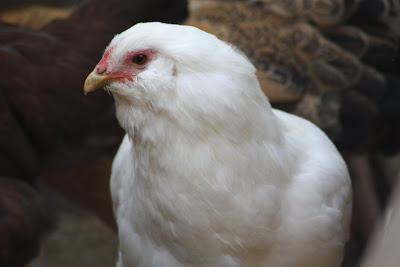
And finally here is my baby, Pop Tart. She is a Silver Laced Wyandotte and so far seems to be the tamest of the birds. I'm not surprised. Check out her tail feathers. It definitely looks as though she's met with some hen honcho who has been at her like a bully on an elementary school playground.

Speaking of bullying, Sweet Pea is not taking to her new flock mates as well as I had expected. I witnessed her deliver some seriously severe pecks to Eggo, and she chomped down on Pop Tart's behind, holding onto that one scraggly feather she has sticking up back there. I guess the ladies are establishing their pecking order and that's never pretty. Sweet Pea is being territorial, puffing up her chest feathers whenever she gets the chance, and uttering her low, kind of spooky, squawky noises. She appears to want the others to know that she was here first.
On Sunday, we packed ourselves into two vehicles for a gorgeous drive up to Petaluma. The air had the crispness of fall, yet a skin tingling warmth from the sun's rays. I was excited to bring my parents along for this adventure; I wanted them to catch a glimpse of some of the more exciting moments of my urban farm life. My mother had grown up on a dairy in Southern California and clearly remembers her mother, Gertrude, raising the farm's chickens while harboring a seething disgust for the creatures. I suppose they are not for everyone. Though I am quite enamored with them, which was evident to my mother by my more than jubilant mood on the hour plus journey.
I had made an appointment to pick up four ladies from Split Rail Farms, which is nestled just outside of Petaluma in a town called Penngrove. In a rare moment of promptness, we arrived exactly when I said we would. Those who know me well will know that this is nothing short of miraculous. The farm headmistress, Jane, had our birds in cages, all ready to go to their new home. Everything seemed so efficient and neat. My mom made some offhand comment that hopefully these chickens would... you know... live. I told Jane that we had lost 6 out of 7 birds. Shocked, she asked if we had lost them to predators. I explained that the birds died of Marek's because of having purchased unvaccinated birds from a lady in - "Cotati", she abruptly answered for me. It seems Jane fell prey to the same swindle I had. Our stories were similar except that she chose to make the trip in person to UC Davis with a live bird. She said a dead bird in the refrigerator made her squeamish. I assured her that I double bagged mine in the fridge before I sent via Fedex.
Split Rail also has a herd of Nigerian Dwarfs. We asked a load of goat questions, which the folks on the farm were more than happy to answer. They were so young for farmers, at least a decade younger than me and my DF. And so incredibly... sweet. I hate to sound so sappy, but they were really really nice folks who kindly took the time to show us around a little and answer any weird query we threw out. We spent a good 15 minutes watching the chickens roam freely through the garden, the goats trot about with one of the farm's dogs, and the flock of wild turkeys frolicking in the background as if they too belonged to the farm.
After a bit of chit chatting we found out that the Split Rail farmers both had jobs off the grange. And then it dawned on me why that magazine, which I always thought should be called "Small Farms", is called Hobby Farms - you can't really make a living as a small farmer. Some folks might be able to scrape by, but they are probably more of a rarity in this day and age. I'm glad to see the younger kids giving it a try. I wish them the best of luck. And if these chickens live and actually lay eggs for me, I will recommend them to all my friends in search of poultry partnerships.
I know, I know, enough with the rambling. You're thinking, "Get to the chickens lady!".
This is Cocoa Puff, the Disgruntled Farmhand's bird. She is a Cuckoo Maran, like Pearl, and will give us those dark chocolate brown eggs.

Here is Ute's lady Fruit Loop, a Welsummer like Miss Lorraine, who will also lay dark brown eggs. She is loud, feisty as all get out, and can take to flight more gracefully than any of the other chickens I have owned. I can only catch her if I corner her under the goat deck stairs.

This white beauty also belongs to Ute and is named Eggo, an Ameracauna who will hopefully give us green eggs. She is the same breed as Petunia, "the Asshole", just a different color.

And finally here is my baby, Pop Tart. She is a Silver Laced Wyandotte and so far seems to be the tamest of the birds. I'm not surprised. Check out her tail feathers. It definitely looks as though she's met with some hen honcho who has been at her like a bully on an elementary school playground.

Speaking of bullying, Sweet Pea is not taking to her new flock mates as well as I had expected. I witnessed her deliver some seriously severe pecks to Eggo, and she chomped down on Pop Tart's behind, holding onto that one scraggly feather she has sticking up back there. I guess the ladies are establishing their pecking order and that's never pretty. Sweet Pea is being territorial, puffing up her chest feathers whenever she gets the chance, and uttering her low, kind of spooky, squawky noises. She appears to want the others to know that she was here first.
Tuesday, November 3, 2009
The Results Are In
Wow, that was fast. I wasn't expecting to hear back from the California Animal Health and Food Safety Lab for a couple more weeks. Glad to know that something in our great state is running efficiently. Arnold could take a tip.
This entire chicken ordeal has had me vacillating between various diagnosis, armed only with my online vet education. It's like the blog version of "Stump the Chumps" with the Magliozzi brothers, except I know way less about chicken diseases than they know about cars. Let's see, I started with Coccidiosis, an easily treatable disease so if any chickens had it, it was gone in a week. We could rule that out as my mysterious bird killer. Then I went on to Marek's since the cluckers all seemed to suffer from some kind of paralysis before they bit the dust. This seemed plausible, but since the ladies were supposedly vaccinated and most of the birds died after 17 weeks of age, I began to believe that they had Avian Leukosis, which is symptomatically similar to Marek's but has a 16 week incubation period.
Well somewhere along the line I was right and in typical Tom and Ray fashion, I'm going to blow the brass horns and claim victory. Gertrude died of Marek's, plain and simple. No Cocci, no Avian Influenza, no Leukosis. This was not my fault. Clearly, I was misled. The chicks had not been vaccinated and my hens died of one of the most common and virulent diseases that exists in the poultry world. This is fantastic news! I know you're wondering why I would make such an outrageous claim with 6 dead bodies on my hands. I'll tell you why; I'm not going to have to temporarily depopulate the farm, warn my neighbors, don a hazmat suit with NIOSH/MSHA approved respirator, and decontaminate my property with a turbo anti-pathogenic spray. Marek's is absolutely everywhere and the only proven effective method of controlling the disease is through vaccination. That in itself is a huge load off my mind. And it means I can get new chooks! That is as long as they've been vaccinated as Sweet Pea will remain a carrier for life.
Guess where I'll be this weekend? That's right. Out cruising chicks.
This entire chicken ordeal has had me vacillating between various diagnosis, armed only with my online vet education. It's like the blog version of "Stump the Chumps" with the Magliozzi brothers, except I know way less about chicken diseases than they know about cars. Let's see, I started with Coccidiosis, an easily treatable disease so if any chickens had it, it was gone in a week. We could rule that out as my mysterious bird killer. Then I went on to Marek's since the cluckers all seemed to suffer from some kind of paralysis before they bit the dust. This seemed plausible, but since the ladies were supposedly vaccinated and most of the birds died after 17 weeks of age, I began to believe that they had Avian Leukosis, which is symptomatically similar to Marek's but has a 16 week incubation period.
Well somewhere along the line I was right and in typical Tom and Ray fashion, I'm going to blow the brass horns and claim victory. Gertrude died of Marek's, plain and simple. No Cocci, no Avian Influenza, no Leukosis. This was not my fault. Clearly, I was misled. The chicks had not been vaccinated and my hens died of one of the most common and virulent diseases that exists in the poultry world. This is fantastic news! I know you're wondering why I would make such an outrageous claim with 6 dead bodies on my hands. I'll tell you why; I'm not going to have to temporarily depopulate the farm, warn my neighbors, don a hazmat suit with NIOSH/MSHA approved respirator, and decontaminate my property with a turbo anti-pathogenic spray. Marek's is absolutely everywhere and the only proven effective method of controlling the disease is through vaccination. That in itself is a huge load off my mind. And it means I can get new chooks! That is as long as they've been vaccinated as Sweet Pea will remain a carrier for life.
Guess where I'll be this weekend? That's right. Out cruising chicks.
Tuesday, October 27, 2009
The Last Hen Standing
As I write this, Gertrude's stiff little body is on its way to the California Animal Health and Food Safety Laboratory at UC Davis. After 3 days of hobbling around the coop mostly paralyzed, using her wings, haunches, and beak to ambulate, my beautiful Brabanter finally passed. Ever since Violet and Petunia met their maker, I had planned to send the next chicken that died off to be tested. I found out that UC Davis provides this service for free to folks who own less than 500 birds. Since these tests can be quite pricey if performed by a private lab, I was more than relieved to find out my pocket book wasn't going to continue to take a beating when it came to the chickens. A few plastic bags, a cardboard box, some gel freezer packs and a Jackson to Fedex were all it took to get Gertrude on the way to her necropsy (animal autopsy).
A few folks have expressed concern about the method of shipment, particularly with the unpleasant possibility of leakage. To everyone who has been worried for the poor folks who deliver packages (and I'm sure they thank you for your concern), that's what the plastic bags were for. I, too, was a bit uneasy with shipping a corpse, but apparently people do this kind of thing all the time. According to the lady at CAHFS, "You can send it Fedex and don't worry, you don't have to tell them what you're shipping." Phew! Though just to be sure, I did double bag the bird with extra large plastic bags which wrapped around the chook's thin frame a couple times. In the end, it was more like a quadruple bagging.
The exchange with the man at Fedex was a touch... odd. He wanted me to change boxes. I told him it was impossible; the box was carefully packed. "It's fragile," I said. That's not really a lie. He then picked up the box and asked me if it was frozen. I felt my Operation Send Dead Animal was becoming less and less covert with every dreaded question. As soon as my money hit the table, I shot out the door like a shoplifter who had just finished stuffing loot down her pants.
So now we wait. Meanwhile, I can't bear to put poor Sweet Pea in the run by herself. Until we get the results back, she will be hanging with the goats. They seem to get along, though the goats insist on eating the chicken food and jumping inside the coop. Sweet Pea tolerates their poor manners, if only for the sake of companionship.

A few folks have expressed concern about the method of shipment, particularly with the unpleasant possibility of leakage. To everyone who has been worried for the poor folks who deliver packages (and I'm sure they thank you for your concern), that's what the plastic bags were for. I, too, was a bit uneasy with shipping a corpse, but apparently people do this kind of thing all the time. According to the lady at CAHFS, "You can send it Fedex and don't worry, you don't have to tell them what you're shipping." Phew! Though just to be sure, I did double bag the bird with extra large plastic bags which wrapped around the chook's thin frame a couple times. In the end, it was more like a quadruple bagging.
The exchange with the man at Fedex was a touch... odd. He wanted me to change boxes. I told him it was impossible; the box was carefully packed. "It's fragile," I said. That's not really a lie. He then picked up the box and asked me if it was frozen. I felt my Operation Send Dead Animal was becoming less and less covert with every dreaded question. As soon as my money hit the table, I shot out the door like a shoplifter who had just finished stuffing loot down her pants.
So now we wait. Meanwhile, I can't bear to put poor Sweet Pea in the run by herself. Until we get the results back, she will be hanging with the goats. They seem to get along, though the goats insist on eating the chicken food and jumping inside the coop. Sweet Pea tolerates their poor manners, if only for the sake of companionship.

Thursday, September 24, 2009
Farm of DEATH!
Sounds like an awesomely bad B movie, eh? Well if you want to see it, there's a showing going on in my backyard. Yes, dear readers, we lost two more feathered friends, Violet and Petunia. I've only got a couple ladies left and these days I often find them huddled together looking tense, as if the Grim Reaper were hot on their heels. I hate to tell them, I think he is.
Petunia inconveniently kicked the bucket the morning of my daughter's 6th birthday. Ute's present this year? A good lesson in the hard knocks of life. Before rushing off to school, she held a dying chicken in her arms, hopefully giving that bird a comforting send off towards the great hen house in the sky. Raising peeps was supposed to teach my child about the cycles of life. Instead she is getting a crash course in all things death. I am unnerved by the fact that Ute no longer associates chickens with laying eggs, but with looking cute for a while and then suddenly dropping dead. And why wouldn't she? Christ, this season's tomato plants have lasted longer than the damn hens!
Violet hadn't been acting like herself for several days before her death. Nothing too alarming. She just tended to be off by herself, separating from the rest of the flock. And when I would pet her, she would crouch down rather than pushing back up against my hand, which was her usual m.o. I had read that this was a sign that the hen was about to start laying and since the ladies were approaching that time, I didn't think too much of it. Then last Thursday morning I found her sprawled out underneath the feeder. I shrieked at the sight (I am not ashamed to be a shrieker). To add to the gruesomeness of the scene, I saw that she was still alive, gasping for air and unable to lift her head or move her legs. I cradled her in my arms and stroked her until she left this world.
I knew Petunia wouldn't make it more than a day longer than Violet. She had also been acting a little depressed and was no longer living up to her nickname, "the Asshole". In the evening when I was putting the ladies to bed, I was heartened when she executed an amazing 180 on the roosting bar so that she could snack from the feeder without losing her spot. I stretched my hand out to pet my girls before I closed up the coop and Petunia whipped out her wings, sheltering Sweet Pea and Gertrude on either side of her like a good mother hen. And to let me know who was boss, she gave me a peck on the hand. I was thrilled to see her back to her old tricks. But the next morning, I found her prostrate on the floor of the coop, having fallen off the roosting bar, in the same position as Violet with the same symptoms. However, death was not so swift for her. She held on for a solid half hour and when I tried to lay her down so that I could get Ute ready for school, she freaked, squawking as hard as she could muster and moving any body part that wasn't paralyzed. I couldn't let her die in such a state. So I swaddled her in a tea towel, carrying her upstairs like a baby. And that is how my daughter came to hold a dying chicken on her birthday. We used it as a teaching moment, discussing how it was a precious thing to be able to give someone we care for a loving departure. [What? It's not my fault the bird decided to make her exit on this day. I'll put an extra $75 in the therapy jar. It'll pay for at least a half of a session. Happy now?]
Discouraged. Dismayed. Demoralized. Disheartened. Dispirited. Distressed. Why do all of my feelings start with the letter "D". I digress. I imagine that many of you out there might be thinking, "Wow, chickens must be extremely fragile creatures!", or maybe "Heidi doesn't know enough about poultry to pull this off.", or even "See I told you raising chickens in the city is a bad idea." I don't blame you. It's not like I haven't thought these things myself. But I don't think any of them are necessarily true. Chickens are super easy to care for: food, water, predator proof housing, roosting bar, laying box... done! The tricky parts? Predators and disease. There are over 200 poultry diseases and a few of them are some mean ass, fucked up sicknesses (pardon my french). And if you buy your birds from a sketchy breeder, you're certain to have a few nasty illnesses smuggling themselves inside those cute puffs of fluff.
I'm pretty sure my birds died of Marek's, which I have astutely assessed with that online Vet degree I've been working towards. In vaccinated birds, deaths due to Marek's shouldn't surpass 5% and in unvaccinated flocks you might be looking at 60%. According to the breeder whom I purchased the chicks from, all of the birds were vaccinated. I don't know if I'm buying that. I'm probably going to be looking at 80-100% mortality. Gertrude is not growing, though she eats like a pig. And both birds are dropping feathers. That's been the first sign with this bug. I can't know for sure unless I get a necropsy, which would require driving to Davis, paying a fee for the services, and possibly culling one of the two remaining birds. That doesn't sound appealing to me. My killing days are done for now.
Maybe the birds were vaccinated and I'm just horribly unlucky. As my dad says, "Just because you're paranoid doesn't mean that the world isn't out to get you." He also warned me that I would need to learn a lot about poultry diseases BEFORE I got the chickens. He's probably sitting behind his computer right now doing an "I told you so!" dance. [You stop that right now dad! I know you're doing it. Not funny!]
I had several email exchanges with the breeder. She told me that she had autopsies on her birds last year and they found Marek's and Cocci in her flock. She copped to both of those diseases when I picked up the second batch of birds, so I'm not going to hold that against her. I'll give her credit for trying to be helpful. But when she told me that she would be relocating her operation and alluded to the fact that it had to do with disease issues, I absolved myself of any potential wrongdoing in the raising of my ladies. She offered to replace my birds, which felt more like she was trying to unload the dead weight (pun intended) to avoid bringing it to a new location. I politely declined, but thought to myself "You couldn't pay me to take your chickens lady, no matter how pretty and tempting they are."
So what am I going to do now? Well I guess I'm going to let the girls live out their natural lives and simply wait for them to meet their maker. One of my fears is that only one will survive and then I will HAVE to introduce at least one new chicken (remember chickens are not loners) to the property. The 2 remaining birds are probably carriers of whatever they have so that means as long as they are around, there is still potential for more losses as they will infect any birds they are housed with. I suppose I will have to cross that bridge when I come to it. I don't think I can deal with one more dead animal. Mostly because I have run out of places to bury them.
Heidi's Hard Learned Top 5 Tips on Purchasing Chickens:
1. Purchase birds from a reputable breeder. Ask around. Don't go with any Tom, Dick, or Harry. Who knows what kind of nasties they have infesting their operation.
2. Buy vaccinated birds. It's not a 100% guarantee, but it could save you some heartache.
3. The bird should look healthy: bright eyes, plucky spirit, no drippy nose or eyes, have meat on its breast (the keel or breastbone should not stick out so much that it feels like a spatula), no pasted up vents, no signs of mites. Have a chicken owner friend come with you. They'll know what healthy looks like.
4. Know how to keep your birds healthy by having some general knowledge of common poultry issues: mites, illnesses, treating injuries, appropriate feed and supplements.
5. See #1.
R.I.P. Petunia and Violet. You were good, and very good looking, chickens.

Petunia inconveniently kicked the bucket the morning of my daughter's 6th birthday. Ute's present this year? A good lesson in the hard knocks of life. Before rushing off to school, she held a dying chicken in her arms, hopefully giving that bird a comforting send off towards the great hen house in the sky. Raising peeps was supposed to teach my child about the cycles of life. Instead she is getting a crash course in all things death. I am unnerved by the fact that Ute no longer associates chickens with laying eggs, but with looking cute for a while and then suddenly dropping dead. And why wouldn't she? Christ, this season's tomato plants have lasted longer than the damn hens!
Violet hadn't been acting like herself for several days before her death. Nothing too alarming. She just tended to be off by herself, separating from the rest of the flock. And when I would pet her, she would crouch down rather than pushing back up against my hand, which was her usual m.o. I had read that this was a sign that the hen was about to start laying and since the ladies were approaching that time, I didn't think too much of it. Then last Thursday morning I found her sprawled out underneath the feeder. I shrieked at the sight (I am not ashamed to be a shrieker). To add to the gruesomeness of the scene, I saw that she was still alive, gasping for air and unable to lift her head or move her legs. I cradled her in my arms and stroked her until she left this world.
I knew Petunia wouldn't make it more than a day longer than Violet. She had also been acting a little depressed and was no longer living up to her nickname, "the Asshole". In the evening when I was putting the ladies to bed, I was heartened when she executed an amazing 180 on the roosting bar so that she could snack from the feeder without losing her spot. I stretched my hand out to pet my girls before I closed up the coop and Petunia whipped out her wings, sheltering Sweet Pea and Gertrude on either side of her like a good mother hen. And to let me know who was boss, she gave me a peck on the hand. I was thrilled to see her back to her old tricks. But the next morning, I found her prostrate on the floor of the coop, having fallen off the roosting bar, in the same position as Violet with the same symptoms. However, death was not so swift for her. She held on for a solid half hour and when I tried to lay her down so that I could get Ute ready for school, she freaked, squawking as hard as she could muster and moving any body part that wasn't paralyzed. I couldn't let her die in such a state. So I swaddled her in a tea towel, carrying her upstairs like a baby. And that is how my daughter came to hold a dying chicken on her birthday. We used it as a teaching moment, discussing how it was a precious thing to be able to give someone we care for a loving departure. [What? It's not my fault the bird decided to make her exit on this day. I'll put an extra $75 in the therapy jar. It'll pay for at least a half of a session. Happy now?]
Discouraged. Dismayed. Demoralized. Disheartened. Dispirited. Distressed. Why do all of my feelings start with the letter "D". I digress. I imagine that many of you out there might be thinking, "Wow, chickens must be extremely fragile creatures!", or maybe "Heidi doesn't know enough about poultry to pull this off.", or even "See I told you raising chickens in the city is a bad idea." I don't blame you. It's not like I haven't thought these things myself. But I don't think any of them are necessarily true. Chickens are super easy to care for: food, water, predator proof housing, roosting bar, laying box... done! The tricky parts? Predators and disease. There are over 200 poultry diseases and a few of them are some mean ass, fucked up sicknesses (pardon my french). And if you buy your birds from a sketchy breeder, you're certain to have a few nasty illnesses smuggling themselves inside those cute puffs of fluff.
I'm pretty sure my birds died of Marek's, which I have astutely assessed with that online Vet degree I've been working towards. In vaccinated birds, deaths due to Marek's shouldn't surpass 5% and in unvaccinated flocks you might be looking at 60%. According to the breeder whom I purchased the chicks from, all of the birds were vaccinated. I don't know if I'm buying that. I'm probably going to be looking at 80-100% mortality. Gertrude is not growing, though she eats like a pig. And both birds are dropping feathers. That's been the first sign with this bug. I can't know for sure unless I get a necropsy, which would require driving to Davis, paying a fee for the services, and possibly culling one of the two remaining birds. That doesn't sound appealing to me. My killing days are done for now.
Maybe the birds were vaccinated and I'm just horribly unlucky. As my dad says, "Just because you're paranoid doesn't mean that the world isn't out to get you." He also warned me that I would need to learn a lot about poultry diseases BEFORE I got the chickens. He's probably sitting behind his computer right now doing an "I told you so!" dance. [You stop that right now dad! I know you're doing it. Not funny!]
I had several email exchanges with the breeder. She told me that she had autopsies on her birds last year and they found Marek's and Cocci in her flock. She copped to both of those diseases when I picked up the second batch of birds, so I'm not going to hold that against her. I'll give her credit for trying to be helpful. But when she told me that she would be relocating her operation and alluded to the fact that it had to do with disease issues, I absolved myself of any potential wrongdoing in the raising of my ladies. She offered to replace my birds, which felt more like she was trying to unload the dead weight (pun intended) to avoid bringing it to a new location. I politely declined, but thought to myself "You couldn't pay me to take your chickens lady, no matter how pretty and tempting they are."
So what am I going to do now? Well I guess I'm going to let the girls live out their natural lives and simply wait for them to meet their maker. One of my fears is that only one will survive and then I will HAVE to introduce at least one new chicken (remember chickens are not loners) to the property. The 2 remaining birds are probably carriers of whatever they have so that means as long as they are around, there is still potential for more losses as they will infect any birds they are housed with. I suppose I will have to cross that bridge when I come to it. I don't think I can deal with one more dead animal. Mostly because I have run out of places to bury them.
Heidi's Hard Learned Top 5 Tips on Purchasing Chickens:
1. Purchase birds from a reputable breeder. Ask around. Don't go with any Tom, Dick, or Harry. Who knows what kind of nasties they have infesting their operation.
2. Buy vaccinated birds. It's not a 100% guarantee, but it could save you some heartache.
3. The bird should look healthy: bright eyes, plucky spirit, no drippy nose or eyes, have meat on its breast (the keel or breastbone should not stick out so much that it feels like a spatula), no pasted up vents, no signs of mites. Have a chicken owner friend come with you. They'll know what healthy looks like.
4. Know how to keep your birds healthy by having some general knowledge of common poultry issues: mites, illnesses, treating injuries, appropriate feed and supplements.
5. See #1.
R.I.P. Petunia and Violet. You were good, and very good looking, chickens.

Sunday, August 16, 2009
Greetings, IBFITC readers!
I've been hard at work on the farm with my sweetheart and fully gruntled farmhand, Jeremiah, so I haven't had much chance to sit down and pound out a proper update to the ol' blog until today, our last day!
We were thrilled when Heidi, Esteban the Disgruntled Farmhand (typing 'gruntled' makes me giggle), and Ute welcomed us to their home. We were both looking forward to spending some time out of the 'burbs, frolicking with goats and watching chickens act chicken-like. Since both of us have become interested in the urban homesteading movement (it's big enough to be called a 'movement', right?), we were particularly excited to learn more about what goes into creating a more self-sufficient household. And ooo-wee! We got us an edumacation!
Contrary to common belief, I was not a farm kid. I grew up in Bodega Bay, which I call a town but the tourist brochures call a quaint village, and my dad was a fisherman. Aside from our kleptomaniacal dog Skipper, thousands of nameless feral cats, and one Muscovy duck named Buddy bought on a whim at the feed store (when I lost interest and realized the duck couldn't live on love alone, my brother rechristened him Guido, took him to his house, and later ate him), we didn't keep animals. I liked to look at them, and like many little girls, I wanted a black pony with a star on his forehead more than anything in the world, but for the most part I viewed farm animals as big, smelly alien creatures who magically provided us with beef and chicken. My sole contact with livestock came when I was a teenager living with my sister, Deb, who for some reason decided she needed to have two goats penned up in the backyard. Their names were Orion and Snowy, and I hated them. Yeah, I said it. I hated them. I don't know if they were mean or just acting, like, goat-y, but no matter what I did, those damned goats would rear up on their hind legs and jump on me, like they were trying to dance with me or something, and then they'd drop to the ground, rev themselves up, and butt me. They wouldn't even let me pet them without butting me. Though I'd expressed no interest in the goats, outside of the desire anyone would have to keep them safe from Chupacabra or goat rustlers, Deb felt that it was my job to take care of them. I'd go outside, grimly clutching the feed bucket, as the goats fixed their walleyed stare upon me. I'd open the gate and BOOM! the assault would begin. I think my sister had purely sadistic motives, because she found this uproariously funny.
I'd related this story to Heidi and her DF, and Heidi was a tidge worried that I may have been too traumatized by my sucky goat experience to take proper care of her farm. But no. I told her that I've grown up and I think animals are fun now, not to mention the fact that her goats are cute, a little skittish, and much sweeter than the snarling beasts my sister kept. Jeremiah was just excited to play chicken farmer for two weeks, and he had no fear of goats to speak of.
We arrived at the Itty-Bitty eager to get our hands dirty. We read through Heidi's instructions, and set about divvying up the chores, though we liked doing the work (and we're still in that gross snuggly stage of our relationship) so much we ended up abandoning the list to do everything together. The work was pretty straightforward--clean food and water for all the animals everyday, rake the pen a couple times. J and I immediately loved the scent of the goat's feed--molasses, corn, oats--and even grew to enjoy the loamy smell of the pen in the morning, earth and dewy straw and sweet alfalfa. The goats weren't down with us petting them, but we were consoled by the fact that they regarded us with curiosity, not malice.
Chickens are amusing creatures, and we enjoyed watching them cluck and peck. That's their jam, you know. I'm sorry to say that Lorraine has departed this mortal coil. She began acting strangely midday Wednesday, and took her last breaths by evening. Jeremiah brought her inside and made her a bed of shavings, and tried to feed her bits of fruit; we knew she might not make it when she took no notice of an earwig crawling over her beak. No matter how large or small the creature, it's always bad news when it refuses to eat. She died a peaceful, natural death. I have to admit that I was terrified I might have to euthanize her, especially after reading Heidi's harrowing post on that subject. RIP, Lorraine.
I guess I don't have anything earthshaking to share on the topic of animal care. It was fun and cute. But I have to say that my experience here has raised a lot of questions about the food I eat and the lifestyle I lead.
With Heidi's permission, I pillaged her cabinets and found homemade preserves, home-canned beets and asparagus, and homemade applesauce. The freezer is full of the meat of ethically raised animals who didn't die in abject misery, stuffed full of corn and drugs before being cruelly slaughtered. Apples from the neighbor's tree are waiting to be turned into cobbler in the refrigerator. Heidi's tomatoes--both home-grown and out of the CSA box--are rich and flavorful. All the great things about ye olden dayes, with the added benefits of penicillin and hair dryers. Cooking next to Jeremiah, I found myself stating the obvious: "Honey! Taste this apple! It's real and tart and hasn't been engineered to do unnatural things! We're eating a REAL apple! Wow!" Poor guy. He's very patient. I've become very aware of the fact that even though I eat quite well--whole foods, mostly vegan (I really love honey), little to no artificial yuckiness--I'm still eating products. My Safeway tomato isn't bland because it's a dud, it's bland because it's been sitting in a greenhouse, artifically ripening. It's the result of a process designed to sell more tomatoes, not provide nourishment. I've already collected a bunch of containers so I can start my own tomato and herb garden, to begin the process of reducing the amount of products I consume.
Most people were incredulous when I told them I'd be farmsitting in the city, especially when I mentioned the goats. People have no qualms about keeping Rottweilers and Mastiffs in a city home, but goats! Well, that's just crazy talk. But the fact is, there's no reason one can't keep a couple of foodbeasts in the city (yes, okay--there may be zoning laws and boring stuff like that. But I'm talking about something DEEPER). There's no reason one can't raise a 3' x 3' patch of corn or make homemade yogurt. We don't have to live the way we were taught, and we don't have to pigeonhole ourselves into city or country boxes.
My homestead may never be self-sufficient, because I am all too happy to pay someone else to make my bread or collect my honey. But I liked the way it felt to peer into the pantry and find a stockpile of handmade food. So, it's baby steps for me--Heidi gave me a home canning kit as a thank-you, and I plan to can the hell outta anything I can find. I'm excited to rehabilitate my plant-killing black thumb, and I have a good lead on a free vermiculture bin so I can rightly call myself a worm farmer.
It's going to be fun.
I've been hard at work on the farm with my sweetheart and fully gruntled farmhand, Jeremiah, so I haven't had much chance to sit down and pound out a proper update to the ol' blog until today, our last day!
We were thrilled when Heidi, Esteban the Disgruntled Farmhand (typing 'gruntled' makes me giggle), and Ute welcomed us to their home. We were both looking forward to spending some time out of the 'burbs, frolicking with goats and watching chickens act chicken-like. Since both of us have become interested in the urban homesteading movement (it's big enough to be called a 'movement', right?), we were particularly excited to learn more about what goes into creating a more self-sufficient household. And ooo-wee! We got us an edumacation!
Contrary to common belief, I was not a farm kid. I grew up in Bodega Bay, which I call a town but the tourist brochures call a quaint village, and my dad was a fisherman. Aside from our kleptomaniacal dog Skipper, thousands of nameless feral cats, and one Muscovy duck named Buddy bought on a whim at the feed store (when I lost interest and realized the duck couldn't live on love alone, my brother rechristened him Guido, took him to his house, and later ate him), we didn't keep animals. I liked to look at them, and like many little girls, I wanted a black pony with a star on his forehead more than anything in the world, but for the most part I viewed farm animals as big, smelly alien creatures who magically provided us with beef and chicken. My sole contact with livestock came when I was a teenager living with my sister, Deb, who for some reason decided she needed to have two goats penned up in the backyard. Their names were Orion and Snowy, and I hated them. Yeah, I said it. I hated them. I don't know if they were mean or just acting, like, goat-y, but no matter what I did, those damned goats would rear up on their hind legs and jump on me, like they were trying to dance with me or something, and then they'd drop to the ground, rev themselves up, and butt me. They wouldn't even let me pet them without butting me. Though I'd expressed no interest in the goats, outside of the desire anyone would have to keep them safe from Chupacabra or goat rustlers, Deb felt that it was my job to take care of them. I'd go outside, grimly clutching the feed bucket, as the goats fixed their walleyed stare upon me. I'd open the gate and BOOM! the assault would begin. I think my sister had purely sadistic motives, because she found this uproariously funny.
I'd related this story to Heidi and her DF, and Heidi was a tidge worried that I may have been too traumatized by my sucky goat experience to take proper care of her farm. But no. I told her that I've grown up and I think animals are fun now, not to mention the fact that her goats are cute, a little skittish, and much sweeter than the snarling beasts my sister kept. Jeremiah was just excited to play chicken farmer for two weeks, and he had no fear of goats to speak of.
We arrived at the Itty-Bitty eager to get our hands dirty. We read through Heidi's instructions, and set about divvying up the chores, though we liked doing the work (and we're still in that gross snuggly stage of our relationship) so much we ended up abandoning the list to do everything together. The work was pretty straightforward--clean food and water for all the animals everyday, rake the pen a couple times. J and I immediately loved the scent of the goat's feed--molasses, corn, oats--and even grew to enjoy the loamy smell of the pen in the morning, earth and dewy straw and sweet alfalfa. The goats weren't down with us petting them, but we were consoled by the fact that they regarded us with curiosity, not malice.
Chickens are amusing creatures, and we enjoyed watching them cluck and peck. That's their jam, you know. I'm sorry to say that Lorraine has departed this mortal coil. She began acting strangely midday Wednesday, and took her last breaths by evening. Jeremiah brought her inside and made her a bed of shavings, and tried to feed her bits of fruit; we knew she might not make it when she took no notice of an earwig crawling over her beak. No matter how large or small the creature, it's always bad news when it refuses to eat. She died a peaceful, natural death. I have to admit that I was terrified I might have to euthanize her, especially after reading Heidi's harrowing post on that subject. RIP, Lorraine.
I guess I don't have anything earthshaking to share on the topic of animal care. It was fun and cute. But I have to say that my experience here has raised a lot of questions about the food I eat and the lifestyle I lead.
With Heidi's permission, I pillaged her cabinets and found homemade preserves, home-canned beets and asparagus, and homemade applesauce. The freezer is full of the meat of ethically raised animals who didn't die in abject misery, stuffed full of corn and drugs before being cruelly slaughtered. Apples from the neighbor's tree are waiting to be turned into cobbler in the refrigerator. Heidi's tomatoes--both home-grown and out of the CSA box--are rich and flavorful. All the great things about ye olden dayes, with the added benefits of penicillin and hair dryers. Cooking next to Jeremiah, I found myself stating the obvious: "Honey! Taste this apple! It's real and tart and hasn't been engineered to do unnatural things! We're eating a REAL apple! Wow!" Poor guy. He's very patient. I've become very aware of the fact that even though I eat quite well--whole foods, mostly vegan (I really love honey), little to no artificial yuckiness--I'm still eating products. My Safeway tomato isn't bland because it's a dud, it's bland because it's been sitting in a greenhouse, artifically ripening. It's the result of a process designed to sell more tomatoes, not provide nourishment. I've already collected a bunch of containers so I can start my own tomato and herb garden, to begin the process of reducing the amount of products I consume.
Most people were incredulous when I told them I'd be farmsitting in the city, especially when I mentioned the goats. People have no qualms about keeping Rottweilers and Mastiffs in a city home, but goats! Well, that's just crazy talk. But the fact is, there's no reason one can't keep a couple of foodbeasts in the city (yes, okay--there may be zoning laws and boring stuff like that. But I'm talking about something DEEPER). There's no reason one can't raise a 3' x 3' patch of corn or make homemade yogurt. We don't have to live the way we were taught, and we don't have to pigeonhole ourselves into city or country boxes.
My homestead may never be self-sufficient, because I am all too happy to pay someone else to make my bread or collect my honey. But I liked the way it felt to peer into the pantry and find a stockpile of handmade food. So, it's baby steps for me--Heidi gave me a home canning kit as a thank-you, and I plan to can the hell outta anything I can find. I'm excited to rehabilitate my plant-killing black thumb, and I have a good lead on a free vermiculture bin so I can rightly call myself a worm farmer.
It's going to be fun.
Tuesday, August 4, 2009
New Digs

We finally finished the new animal area. It's basically a long corridor with a 4.5 foot retaining wall at the bottom of our steep sloping yard. Though it looks a tad prison-ish now, a nice coat of bright green paint will certainly improve the aesthetics. I'll get on that as soon as we return from our vacation in Costa Rica. Though I'm not sure the animals really care all that much about the looks of things, they seem to be pleased that they have a bit more room to spread out. Here's a view from the opposite angle:
 The goats are happy.
Lucy keeps attempting to either eat or climb the lattice.

I also just realized that I haven't put up any recent photos of the chickens. And boy are they changing. Check out Gertrude's faux hawk -

She found an interesting spot to roost this morning.

Violet has sprouted a full blown feathered cap. We nicknamed her Phyllis Diller as her hat just looks like something Phyllis would don. I love this picture. You can't see either set of eyes.

I had to really work at getting this rare glimpse of her face.

Sweet Pea is just HUGE compared to 4 weeks ago. She was the smallest of the bunch and now is almost the largest.

And look at those leg feathers!

We will be away through mid-August, so you may not hear from me until then. Meanwhile you may catch wind from my fabulous farm sitters, Maria and Jeremiah, who will be holding down the fort while we're gone. I'm hoping that they will decide to be guest bloggers and give you all a different perspective of the haps around Itty Bitty.
Subscribe to:
Posts (Atom)